Impact Factor ISSN: 1449-1907




Int J Med Sci 2026; 23(11):3506-3514. doi:10.7150/ijms.137426 This issue Cite
Research Paper
The relationship between 5α-reductase inhibitors and the presence of following open angle glaucoma: a TriNetX cohort study
Chia-Yi Lee, MD, PhD1,2,3†, Shun-Fa Yang, PhD1,4†, Shih-Chi Su5†, Yu-Ling Chang, MD6, Jing-Yang Huang, PhD4, Chao-Bin Yeh, MD7,8, Po-Hsien Huang, MD9  , Chao-Kai Chang, MD, PhD3,10
1. Institute of Medicine, Chung Shan Medical University, Taichung, Taiwan.
2. Cerulean Eye Center, Taichung, Taiwan.
3. Nobel Eye Institute, Taipei, Taiwan.
4. Department of Medical Research, Chung Shan Medical University Hospital, Taichung, Taiwan.
5. Whole-Genome Research Core Laboratory of Human Diseases, Chang Gung Memorial Hospital, Keelung, Taiwan.
6. Department of Pediatrics, Cathay General Hospital, Taipei, Taiwan.
7. Department of Emergency Medicine, School of Medicine, Chung Shan Medical University, Taichung, Taiwan.
8. Department of Emergency Medicine, Chung Shan Medical University Hospital, Taichung, Taiwan.
9. Kaohsiung Nobel Eye Institute, Kaohsiung, Taiwan.
10. Graduate Institute of Clinical Medicine, Kaohsiung Medical University, Kaohsiung, Taiwan.
† These authors contribute equally and share the first authorship.
Received 2026-5-8; Accepted 2026-8-14; Published 2026-10-2
Abstract
Purpose: This study was conducted to test a possible association between 5α-reductase inhibitor (5ARI) use and subsequent open-angle glaucoma (OAG).
Method: A retrospective cohort study was conducted, and individuals with benign prostate hyperplasia (BPH) and androgenetic alopecia were included and classified according to whether they received 5ARI treatment. A total of 181,208 individuals were included in each of the 5ARI and non-5ARI groups. The primary outcome was the development of OAG according to diagnostic and procedure codes. Cox proportional hazard regression was performed for the statistical analysis.
Results: OAG occurred in 3477 patients (5.14%) in the 5ARI group and 3044 patients (4.59%) in the non-5ARI group. After adjustment for multiple covariates, exposure to 5ARIs was associated with a significantly greater risk of OAG compared with the non-5ARI treatment (P < 0.001). The cumulative incidence of OAG was significantly higher among patients receiving 5ARI therapy than among those in the non-5ARI group (P < 0.001), and the cumulative incidence of HTG was significantly higher in the 5ARI population than the non-5ARI population (P = 0.002). In the sensitivity analysis, the 5ARI cohort exhibited significantly increased rates of OAG and HTG compared with the non-5ARI cohort, except for Asian individuals (P > 0.05).
Conclusions: The use of 5ARIs may be related to the development of OAG.
Keywords: epidemiology, TriNetX database, finasteride, 5α-reductase inhibitors, open angle glaucoma
Introduction
Hormones play a crucial role in regulating human metabolism, tissue remodeling, and reproductive physiology [1]. Among the various endocrine mediators of the human body, androgens are particularly important for the development of both male reproductive organs and secondary sexual characteristics [2]. In addition to their physiological significance, androgens may also participate in the pathogenesis of certain disorders, including benign prostatic hyperplasia (BPH) and androgenetic alopecia [3-5]. To manage these androgen-dependent disorders, 5α-reductase inhibitors (5ARIs) have been used for many years, and previous studies have generally reported satisfactory therapeutic efficacy for this approach [6, 7].
Although 5ARI therapy can effectively treat androgen-associated diseases, its use has also been linked to several adverse events and related comorbidities [8, 9]. Earlier research suggested that exposure to 5ARIs may increase the likelihood of insulin resistance and type 2 diabetes mellitus [9]. Sexual and reproductive complications have also been described, including a greater occurrence of erectile dysfunction and impaired fertility among patients receiving 5ARI treatment [10]. In addition, another publication reported a possible association between the administration of 5ARIs and an elevated risk of depressive disorders [11]. Furthermore, a recent review article indicated that 5ARI use may be associated with the development of bladder and kidney cancers [12].
Open-angle glaucoma (OAG) is an ocular disease characterized by visual field defects and can be classified as either high-tension glaucoma (HTG) or normal-tension glaucoma (NTG) [13, 14]. In previous research, the development of OAG has been linked to other medications, including corticosteroids and calcium channel blockers [15]. However, few studies have evaluated the potential association between OAG and 5ARI use. Because 5ARIs may interfere with the vasculature and vascular defects play a critical role in OAG development [16, 17], such an association may exist, thus requiring evaluation.
As a result, the objective of this study is to investigate the association between 5ARI use and succeeding OAG episodes. In addition, OAG was divided into HTG and NTG events, and their associations to the 5ARI treatment were analyzed separately.
Materials and Methods
Data Source
This study was conducted in accordance with the principles of the Declaration of Helsinki of 1964 and its subsequent revisions. The Institutional Review Board of Chung Shan Medical University (project code: CS2-23180) approved this research. Data were retrieved from the TriNetX database, a worldwide federated health research network that provides access to electronic medical records from major healthcare organizations, including diagnostic information, laboratory results, procedures, genomic data, and medication records. Analysis was performed using the US Collaborative Network, which includes data from 108 healthcare institutions. TriNetX collects de-identified electronic health information from participating healthcare systems, most of which are large academic medical centers providing both outpatient and inpatient services in different regions of the United States. Through a secure web-based interface, TriNetX Analytics enables access to patient-level electronic health data from primary care facilities, hospitals, and specialty care providers. As a result, the TriNetX database includes patients from varied geographic locations, age groups, racial and ethnic backgrounds, income levels, and insurance categories, including commercial insurance, Medicare, Medicaid, workers' compensation, self-pay, uninsured status, military insurance, and veterans' affairs coverage. The clinical information available in TriNetX includes International Classification of Diseases, Tenth Revision, Clinical Modification (ICD-10-CM) codes; sex; age; employment status; residential information; educational level; socioeconomic and psychosocial factors; hospitalization duration, if available; imaging, laboratory test, surgical, and procedure codes; and Anatomical Therapeutic Chemical (ATC) codes for medications.
Patient Selection
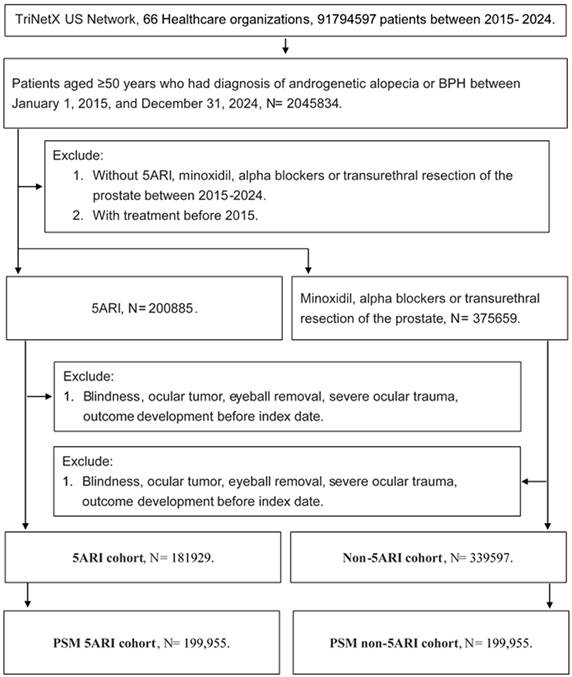
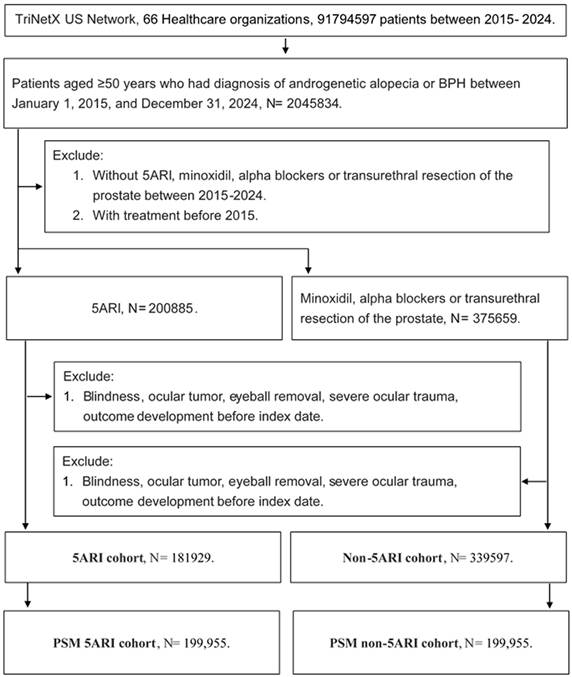
A retrospective cohort design was utilized with data from the TriNetX resource. Eligible patients were selected according to the following criteria: (1) diagnosis of androgenetic alopecia or benign prostatic hyperplasia (BPH) based on relevant ICD-10-CM codes, (2) age greater than 50 years according to demographic records, (3) male sex, and (4) diagnosis of androgenetic alopecia or BPH between January 1, 2015 and December 31, 2024. The index date was defined as three months after the diagnosis of androgenetic alopecia or BPH. To improve the consistency of the baseline ocular status among included individuals, several exclusion criteria were applied. Patients were excluded if they had (1) blindness before the index date according to relevant ICD-10-CM codes, (2) ocular malignancy before the index date, (3) a history of eyeball removal surgery before the index date according to surgical codes, (4) severe ocular trauma before the index date, (5) 5ARI treatment exposure before 2015, or (6) the study outcome developed before the index date. Participants were subsequently divided into two cohorts. The 5ARI group consisted of patients who received 5ARI therapy based on ATC codes, whereas the non-5ARI group included patients treated with minoxidil, alpha blockers, or transurethral resection of the prostate according to ATC and surgical codes. Propensity score matching (PSM) was then performed for the 5ARI and non-5ARI cohorts. The PSM model incorporated demographic characteristics, systemic comorbidities, and laboratory findings into a composite score, and patients in the two groups were matched according to this scoring system. After matching, 181,208 individuals were included in each of the 5ARI and non-5ARI groups. The patient selection process is illustrated in Figure 1.
The flowchart of participant selection. 5ARI: 5α-reductase inhibitors, BPH: benign prostate hyperplasia, N: number, PSM: propensity score matching
Primary Outcome
The primary outcome of this study was the occurrence of OAG after the index date. OAG development was defined using the following criteria: (1) diagnosis of OAG using relevant ICD-10-CM codes; (2) receipt of intraocular pressure/tonometry measurement, optical coherence tomography, or visual field exam according to procedure codes; and (3) confirmation of the OAG diagnosis by an ophthalmologist. All included patients were followed until the first occurrence of the primary outcome, withdrawal from the healthcare insurance system, or the end of the TriNetX database follow-up period, which was December 31, 2024.
Covariate Adjustment
To more accurately evaluate the relationship between 5ARI exposure and subsequent OAG events, the effects of several covariates were incorporated into the multivariable analysis. These variables included age, race, lifestyle factors, socioeconomic and psychosocial conditions, hypertension, diabetes mellitus, ischemic heart disease, hyperlipidemia, cerebrovascular disease, unspecified dementia, vascular dementia, rheumatoid arthritis, ankylosing spondylitis, and systemic lupus erythematosus. These covariates were identified using relevant demographic information, ICD-10-CM codes, and laboratory codes. To ensure that systemic diseases and demographic factors had persisted long enough to potentially affect the risk of OAG, only comorbidities documented for more than two years were included in the subsequent analyses.
Statistical Analysis
All statistical analyses were performed using SAS software, version 9.4 (SAS Institute Inc., Cary, NC, USA). Descriptive statistics were used to summarize the baseline characteristics of the 5ARI and non-5ARI groups. The standardized mean difference (SMD) was calculated to assess between-group differences for each baseline variable, and an SMD greater than 0.1 was considered clinically meaningful in this study. Cox proportional hazards regression analysis was conducted to compare the risk of OAG development between the 5ARI and non-5ARI groups. Adjusted hazard ratios (aHRs) and corresponding 95% confidence intervals (CIs) were calculated for OAG incidence. In addition, age, sex, urbanization level, income level, hypertension, diabetes, ischemic heart disease, hyperlipidemia, cerebrovascular disease, unspecified dementia, vascular dementia, rheumatoid arthritis, ankylosing spondylitis, and systemic lupus erythematosus were included in the Cox regression model to control for their potential influence on OAG occurrence. Kaplan-Meier curves were generated to compare the cumulative incidence of OAG between the two study groups, and differences were evaluated using the log-rank test. Additionally, we classified OAG as HTG and NTG via the ICD-10-CM codes, and we also compared the cumulative incidence of HTG and NTG between the two groups. For sensitivity analyses, individuals were stratified into subgroups according to age, race, hypertension, diabetes mellitus, and dyslipidemia. Cox proportional hazards regression was then repeated to estimate the risk of OAG development within each subgroup. A P value less than 0.05 was considered statistically significant, and values below 0.001 were reported as P < 0.001 in this study.
Results
The baseline characteristics of patients in the 5ARI and non-5ARI cohorts are summarized in Table 1. The average age was 70.8±8.4 years in the 5ARI group and 70.8±8.4 years in the non-5ARI group, with no meaningful difference observed between the two groups (SMD = 0.001). Other demographic variables, including race, socioeconomic and psychosocial factors, and lifestyle-related characteristics, were also comparable between the two cohorts, with SMD values all below 0.1. Similarly, the prevalence of systemic comorbidities was well balanced between the 5ARI and non-5ARI groups, as all corresponding SMD values were less than 0.1 (Table 1).
Baseline characteristics among exposure and control cohort after propensity score matching
| Characteristics | 5ARI cohort | Non-5ARI cohort | SMD |
|---|---|---|---|
| N | 181208 | 181208 | |
| Age at Index | 70.8±8.4 | 70.8±8.4 | 0.001 |
| Race | |||
| White | 134316(74.1%) | 135396(74.7%) | 0.014 |
| African American | 16744(9.2%) | 16189(8.9%) | 0.011 |
| Asian | 10286(5.7%) | 9989(5.5%) | 0.007 |
| Psycho-socioeconomic circumstances | 3028(1.7%) | 2444(1.3%) | 0.026 |
| Lifestyle | |||
| Nicotine dependence | 15398(8.5%) | 14283(7.9%) | 0.022 |
| Alcohol related disorders | 5316(2.9%) | 4533(2.5%) | 0.027 |
| Comorbidities | |||
| Hypertensive diseases | 106596(58.8%) | 106104(58.6%) | 0.006 |
| Dyslipidemia | 90356(49.9%) | 90352(49.9%) | 0.000 |
| Diabetes mellitus | 47040(26.0%) | 46561(25.7%) | 0.006 |
| Ischemic heart diseases | 45162(24.9%) | 44354(24.5%) | 0.010 |
| Cerebrovascular diseases | 17351(9.6%) | 16115(8.9%) | 0.024 |
| Dementia | 6428(3.5%) | 5777(3.2%) | 0.020 |
| Nervous degenerative diseases | 3312(1.8%) | 2881(1.6%) | 0.018 |
| Vascular dementia | 1303(0.7%) | 1096(0.6%) | 0.014 |
| Medication | |||
| Nitrofurantoin | 3245(1.8%) | 2944(1.6%) | 0.013 |
| Hydroxychloroquine | 934(0.5%) | 773(0.4%) | 0.013 |
| Phenothiazines | 565(0.3%) | 462(0.3%) | 0.011 |
| Tamoxifen | 36(0.0%) | 19(0.0%) | 0.008 |
5α-reductase inhibitors: 5ARI, N: number, SMD: standard mean difference
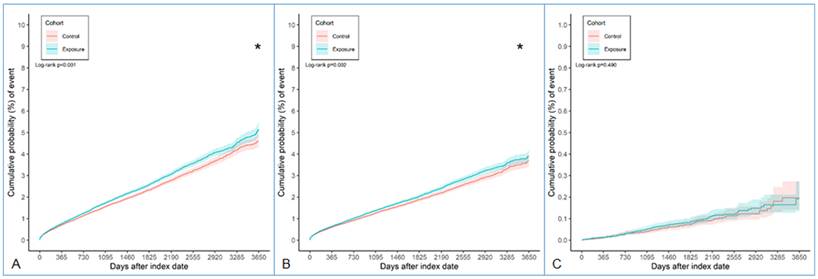
During the entire follow-up period of up to 10 years, OAG occurred in 3477 patients (5.14%) in the 5ARI group and 3044 patients (4.59%) in the non-5ARI group. After adjustment for multiple covariates, exposure to 5ARIs was associated with a significantly greater risk of OAG compared with non-5ARI treatments (aHR: 1.10, 95% CI: 1.05-1.16, P < 0.001) (Table 2). The Kaplan-Meier analysis comparing OAG occurrence between the two cohorts is presented in Figure 2. The cumulative incidence of OAG was significantly higher among patients receiving 5ARI therapy than among those in the non-5ARI group (P < 0.001) (Figure 2A). In addition, the cumulative incidence of HTG and NTG was significantly higher in the 5ARI population than the non-5ARI cohort (P = 0.002) (Figure 2B), while the cumulative incidence of NTG was similar in both the 5ARI and non-5ARI groups (P = 0.490) (Figure 2C).
Open angle glaucoma events in the two groups after follow-up
| Study event | N | Cumulative probability | AHR (95% CI) | P | ||
|---|---|---|---|---|---|---|
| 1-year | 5-year | 10-years | ||||
| OAG | ||||||
| 5AR | 3477 | 0.76 (0.72-0.80) | 2.57 (2.48-2.67) | 5.14 (4.84-5.47) | 1.10 (1.05-1.16) | <0.001* |
| Non-5ARI | 3044 | 0.70 (0.66-0.74) | 2.33 (2.24-2.43) | 4.59 (4.32-4.87) | Reference | |
| HTG | ||||||
| 5AR | 2766 | 0.63 (0.60-0.67) | 2.04 (1.95-2.13) | 3.90 (3.65-4.15) | 1.09 (1.03-1.15) | 0.002* |
| Non-5ARI | 2450 | 0.60 (0.56-0.64) | 1.88 (1.79-1.97) | 3.65 (3.41-3.91) | Reference | |
| NTG | ||||||
| 5AR | 110 | 0.01 (0.01-0.02) | 0.08 (0.07-0.11) | 0.19 (0.13-0.27) | 1.10 (0.84-1.45) | 0.490 |
| Non-5ARI | 96 | 0.01 (0.01-0.02) | 0.07 (0.06-0.09) | 0.20 (0.14-0.27) | Reference | |
5α-reductase inhibitors: 5ARI, aHR: adjusted hazard ratio, CI: confidence interval, HTG: high-tension glaucoma, N: number, NTG: normal-tension glaucoma, OAG: open angle glaucoma. * denotes significant difference between groups
The Kaplan-Meier curve and cumulative incidence of open angle glaucoma between groups. (A) The cumulative incidence of open angle glaucoma. (B) The cumulative incidence of high-tension glaucoma. (C) The cumulative incidence of normal-tension glaucoma. * denotes significant difference between groups
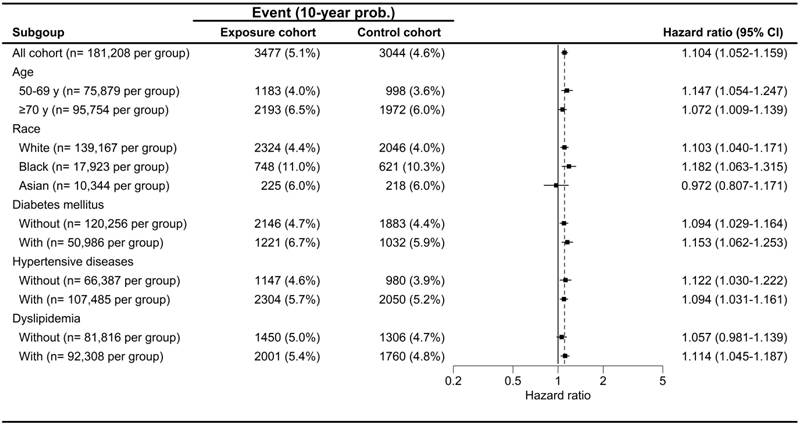
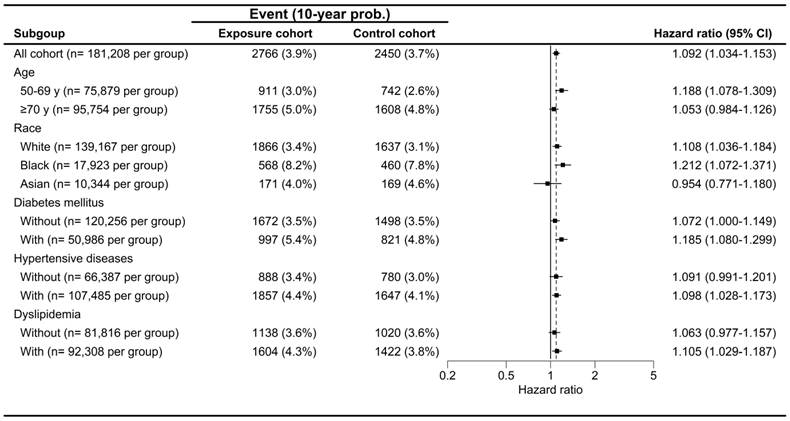
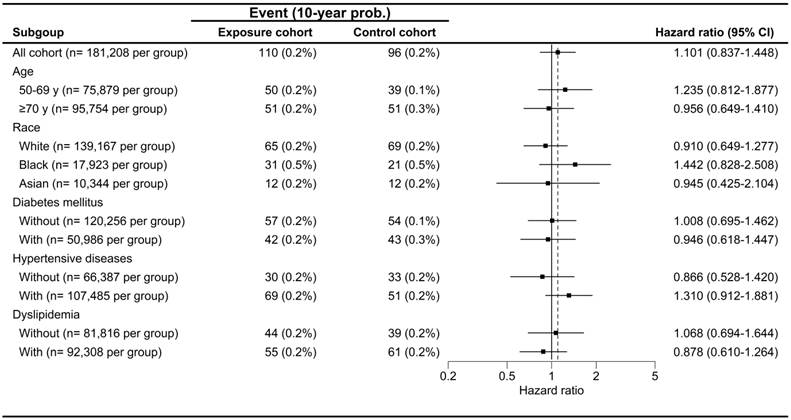
In the sensitivity analysis, the 5ARI cohort exhibited significantly increased rates of OAG compared to the non-5ARI population across different subgroups, except for Asian individuals and those without dyslipidemia (Figure 3). Furthermore, the 5ARI cohort demonstrated significantly increased rates of HTG compared with the non-5ARI cohort across different subgroups except those over 70 years of age, Asians, those without hypertension, and those without dyslipidemia (Figure 4). Conversely, among individuals with different features, there was no difference in the NTG occurrence between subgroups (Figure 5).
Risk of open angle glaucoma in patients with 5α-reductase inhibitors usage stratified by age, race, diabetes mellitus, hypertension and dyslipidemia. CI: confidence interval, N: number
Risk of high-tension glaucoma in patients with 5α-reductase inhibitors usage stratified by age, race, diabetes mellitus, hypertension and dyslipidemia. CI: confidence interval, N: number
Risk of normal-tension glaucoma in patients with 5α-reductase inhibitors usage stratified by age, race, diabetes mellitus, hypertension and dyslipidemia. CI: confidence interval, N: number
Discussion
In previous studies, excess androgen activity has been linked to a variety of disorders involving both reproductive and non-reproductive systems [5, 18]. BPH is characterized by increased androgenic influence, urinary incontinence, and difficulty urinating [18, 19]. Mild forms of BPH may be treated with androgen deprivation therapy, whereas more advanced cases may require surgical intervention, such as transurethral resection of the prostate [18, 20]. In contrast, androgenetic alopecia is primarily associated with elevated androgen activity and progressive hair loss, and it can be managed using minoxidil or anti-androgen therapies such as finasteride [21]. Androgen deprivation therapy is also used in the management of prostate cancer [22]. However, it can lead to several adverse effects, including skin rashes, fatigue, muscle weakness, and metabolic abnormalities [8]. Its use has also been associated with an increased likelihood of sexual dysfunction [6, 8]. In addition, non-alcoholic fatty liver disease has been reported in patients receiving androgen deprivation therapy [9], and vascular defects, such as cardiovascular disease, have been reported in individuals receiving 5ARI therapy [23, 24]. Regarding the mechanisms of HTG and NTG, HTG (or general OAG) is associated with elevated intraocular pressure, retinal ganglion cells, and optic nerve fiber death, while blood flow autoregulation dysfunction may be involved in the development of HTG [13]. NTG also results from intraocular pressure-related retinal ganglion cells and optic nerve fiber death, but additional factors—including ocular perfusion pressure, vascular bed autoregulation, endothelial dysfunction, and oxidative stress—may contribute to its development [14]. In relation to vasculature, OAG is not only significantly associated with intraocular pressure but also vascular defects [13, 25]. In a previous article, individuals with coronary heart disease were linked to a higher incidence of OAG development [26]. Moreover, NTG is influenced by vascular defects, just as the deep macular vasculature was found to be significantly reduced in individuals with NTG in a previous publication [27]. Because 5ARIs may impair the vasculature system and cause ischemic changes, which is a predisposing factor for the development of OAG [13, 14, 24], we speculate that their use may correlate to a higher incidence of OAG. Furthermore, a previous study concluded that the application of 5ARIs may be related to later development of dry eye disease, which indicates a possible effect of 5ARIs on the eyes [28]. Our research results support this idea, at least to some degree.
In the present study, 5ARI exposure was associated with an increased risk of OAG development. Previous studies assessing OAG have reported that the use of certain pharmacologic agents, including corticosteroids and cholesterol-lowering agents, may be linked to a higher likelihood of OAG occurrence compared with control populations [29]. In addition, earlier studies have shown that hormonal components such as estrogen may alter the OAG risk [30]. However, only limited research has specifically examined the relationship between 5ARI therapy and the subsequent development of OAG. To the best of our knowledge, the present work is the first to suggest a positive association between 5ARI therapy and OAG onset. Furthermore, in the Cox proportional hazards regression model, we adjusted for multiple potential predisposing factors of OAG, including age, sex, and diabetes, to minimize their confounding effects. In addition, only OAG events documented after the index date were included, which may have helped to establish a temporal sequence between 5ARI exposure and OAG development. Taken together, these findings suggest that 5ARI use may represent an independent risk factor for the occurrence of OAG. The cumulative probability of OAG development was significantly higher in the 5ARI group than the non-5ARI group, which imply a long-term influence of 5ARIs on OAG risk. In contrast, the cumulative probability of HTG, but not NTG, was significantly higher in the 5ARI group. We think the reason for this difference may due to the low individual numbers in the NTG group, in which the percentage of NTG episodes in all OAG cases was only 3.16%. Still, the AHR of NTG was higher than the AHR of HTG, indicating that 5ARIs may still increase the risk of NTG development if adequate numbers of individuals were enrolled.
In the sensitivity analysis, across different age strata and among patients with metabolic disorders, individuals treated with 5ARIs exhibited a significantly greater risk of OAG and HTG than those in the non-5ARI cohort. In previous studies, age (more than 50) has been recognized as an important predisposing factor for OAG development [13, 31], and our findings are generally consistent with this. An earlier meta-analysis indicated that metabolic syndrome-related conditions, including hypertension, dyslipidemia, and insulin resistance, are linked to an increased risk of OAG occurrence [32]. Similarly, another review suggested that diabetes mellitus may contribute to the development of OAG [15]. The agreement between the results of this study and earlier research further supports the concept that metabolic abnormalities may serve as common risk factors for OAG, not only in the general population but also in specific groups, such as individuals receiving 5ARI therapy. On the contrary, Asian individuals who received 5ARI treatment demonstrated a similar incidence of OAG and HTG compared to Asian participants who did not receive 5ARI treatment. In previous research, Asian race was not a predisposing or protective factor for OAG. Additionally, there was no available pathophysiology explanation for the negative correlation between Asian races and OAG development. Thus, there is a slight conflict between our results and those of previous studies. A possible explanation for this is that the number of individuals in the Asian subgroup was relatively small: there were only 14,634 individuals included in the Asian race subgroup of each cohort. It is possible that the statistical results would change if more individuals were included. Nevertheless, further experimental and clinical research is warranted to determine the mechanism of this association.
From an epidemiological perspective, BPH is highly prevalent, affecting approximately half of men older than 50 [4, 33]. Similarly, androgenetic alopecia is a common condition, with nearly 80% of men in Western populations reported to experience this dermatologic disorder [6]. Given the substantial burden of these two androgen-related diseases, it is estimated that several million individuals receive 5ARI therapy globally [7, 21]. On the other hand, OAG is an ophthalmic burden that affects about 2.93 percent of the European population aged 40-80 years old and more than 66 million individuals in the world [13, 31]. Furthermore, OAG can lead to irreversible visual impairment and has been estimated as the most common cause of irreversible blindness in the world [34]. Because of the high percentage of 5ARI use and OAG in the human population, any relationship between the two factors should be highlighted.
Several limitations of this study should be acknowledged. First, this study employed a database design that relied on diagnostic, laboratory, procedure, and medication codes rather than a direct review of original clinical documents. Therefore, many clinically relevant variables could not be assessed, including imaging findings of BPH, prostate lesion volume, the extent of androgenetic alopecia, results of BPH-related surgeries, treatment adherence among patients with BPH or androgenetic alopecia, therapeutic responses to 5ARIs, possible recurrence of BPH or androgenetic alopecia, detailed information regarding systemic comorbidities, OAG-related symptoms, optical coherence tomography images, visual field test results, treatment response for OAG, and potential OAG recurrence. Secondly, we classified individuals with BPH and androgenetic alopecia as the same population due to the use of 5ARIs. However, the basic pathophysiology of the two diseases is different, and our selection strategy may contribute to analytical inaccuracy. In addition, the retrospective nature of this project could reduce the homogeneity between the two study populations. Despite similar baseline characteristics, some factors—including smoking extent, medication doses, the presence and extent of hypotension, and the presence and extent of high myopia—could not be assessed because of the limited medical records in the TriNetX database. Due to the design of the TriNetX database, we can confirm the time of glaucoma development. However, the details after the glaucoma diagnosis, including the exact type and dosage of glaucoma medications, could not be accessed. This limitation, combined with the absence of visual field tests and optical coherence tomography results, prevented us from performing a glaucoma severity evaluation and could significantly influence the integrity of our conclusions. Finally, we only identified a statistically significant association between 5ARI usage and OAG development, while the exact pathophysiology was not evaluated. The lack of mechanism confirmation could severely reduce the integrity of our results.
In conclusion, the use of 5ARIs may be associated with a higher risk of developing OAG than other non-5ARI treatments. Furthermore, 5ARI therapy may correlate to higher risk of HTG development after adjusting for multiple covariates. Consequently, 5ARIs should be utilized carefully in individuals with known risk factors for OAG development. To evaluate the correlation between 5ARI therapy and OAG outcomes, further prospective, randomized, and large-scale studies are required.
Abbreviations
5ARI: 5α-reductase inhibitor; aHR: adjusted hazard ratio; BPH: benign prostate hyperplasia; CI: confidence interval; eGFR: estimated glomerular filtration rate; HTG: high-tension glaucoma; ICD-10: International Classification of Diseases Tenth Revision; N: number; NTG: normal-tension glaucoma; OAG: open-angle glaucoma; PSM: propensity score matching; SMD: standard mean difference.
Competing Interests
The authors have declared that no competing interest exists.
References
1. Hiller-Sturmhöfel S, Bartke A. The endocrine system: an overview. Alcohol Health Res World. 1998;22:153-64
2. Roy AK, Chatterjee B. Androgen action. Crit Rev Eukaryot Gene Expr. 1995;5:157-76
3. Otberg N, Finner AM, Shapiro J. Androgenetic alopecia. Endocrinol Metab Clin North Am. 2007;36:379-98
4. Vuichoud C, Loughlin KR. Benign prostatic hyperplasia: epidemiology, economics and evaluation. Can J Urol. 2015;22(Suppl 1):1-6
5. Oiwoh SO, Enitan AO, Adegbosin OT, Akinboro AO, Onayemi EO. Androgenetic Alopecia: A Review. Niger Postgrad Med J. 2024;31:85-92
6. Yim E, Nole KL, Tosti A. 5α-Reductase inhibitors in androgenetic alopecia. Curr Opin Endocrinol Diabetes Obes. 2014;21:493-8
7. Miernik A, Gratzke C. Current Treatment for Benign Prostatic Hyperplasia. Dtsch Arztebl Int. 2020;117:843-54
8. Zhang JJ, Shi X, Wu T, Zhang MD, Tang J, Yin GM. et al. Sexual, physical, and overall adverse effects in patients treated with 5α-reductase inhibitors: a systematic review and meta-analysis. Asian J Androl. 2022;24:390-7
9. Traish AM. Health Risks Associated with Long-Term Finasteride and Dutasteride Use: It's Time to Sound the Alarm. World J Mens Health. 2020;38:323-37
10. Haile ES, Sotimehin AE, Gill BC. Medical management of benign prostatic hyperplasia. Cleve Clin J Med. 2024;91:163-70
11. Uleri A, Nicolas Cornu J, Gobbo A, Herrmann TRW, De Nunzio C, Hashim H. et al. Association of 5α-Reductase Inhibitors with Depression and Suicide: A Mini Systematic Review and Meta-analysis. Eur Urol Focus. 2024;10:751-3
12. Doherty N, Cardwell CR, Murchie P, Hill C, Azoulay L, Hicks B. 5α-Reductase Inhibitors and Risk of Kidney and Bladder Cancers in Men with Benign Prostatic Hyperplasia: A Population-Based Cohort Study. Cancer Epidemiol Biomarkers Prev. 2023;32:428-34
13. Weinreb RN, Khaw PT. Primary open-angle glaucoma. Lancet. 2004;363:1711-20
14. Leung DYL, Tham CC. Normal-tension glaucoma: Current concepts and approaches-A review. Clin Exp Ophthalmol. 2022;50:247-59
15. McMonnies CW. Glaucoma history and risk factors. J Optom. 2017;10:71-8
16. Pasquale LR. Vascular and autonomic dysregulation in primary open-angle glaucoma. Curr Opin Ophthalmol. 2016;27:94-101
17. Shores MM, Arnold AM, Biggs ML, Longstreth WT Jr, Smith NL, Kizer JR. et al. Testosterone and dihydrotestosterone and incident ischaemic stroke in men in the Cardiovascular Health Study. Clin Endocrinol (Oxf). 2014;81:746-53
18. Langan RC. Benign Prostatic Hyperplasia. Prim Care. 2019;46:223-32
19. Infante Hernández S, Gómez Rivas J, Moreno Sierra J. Benign prostatic hyperplasia. Med Clin (Barc). 2024;163:407-14
20. Marberger M. Drug Insight: 5alpha-reductase inhibitors for the treatment of benign prostatic hyperplasia. Nat Clin Pract Urol. 2006;3:495-503
21. Varothai S, Bergfeld WF. Androgenetic alopecia: an evidence-based treatment update. Am J Clin Dermatol. 2014;15:217-30
22. Desai K, McManus JM, Sharifi N. Hormonal Therapy for Prostate Cancer. Endocr Rev. 2021;42:354-73
23. Andriole GL, Bostwick DG, Brawley OW, Gomella LG, Marberger M, Montorsi F. et al. Effect of dutasteride on the risk of prostate cancer. N Engl J Med. 2010;362:1192-202
24. Shores MM, Biggs ML, Arnold AM, Smith NL, Longstreth WT Jr, Kizer JR. et al. Testosterone, dihydrotestosterone, and incident cardiovascular disease and mortality in the cardiovascular health study. J Clin Endocrinol Metab. 2014;99:2061-8
25. Son KY, Han JC, Kee C. Parapapillary deep-layer microvasculature dropout is only found near the retinal nerve fibre layer defect location in open-angle glaucoma. Acta Ophthalmol. 2022;100:e174-e80
26. Jung KI, Kim YC, Shin HJ, Park CK. Nationwide cohort study of primary open angle glaucoma risk and cardiovascular factors among in Korean glaucoma suspects. Sci Rep. 2025;15:1952
27. Lee CY, Liu CH, Chen HC, Sun CC, Yao YP, Chao SC. Correlation between Basal Macular Circulation and Following Glaucomatous Damage in Progressed High-Tension and Normal-Tension Glaucoma. Ophthalmic Res. 2019;62:46-54
28. Lee CY, Yang SF, Chang YL, Huang JY, Yeh CB, Yeh FM. et al. The Association Between 5α-Reductase Inhibitors and the Presence of Subsequent Dry Eye Disease in Androgenetic Alopecia: A TriNetX Database Study. Cureus. 2025;17:e99288
29. Boland MV, Quigley HA. Risk factors and open-angle glaucoma: classification and application. J Glaucoma. 2007;16:406-18
30. Patel P, Harris A, Toris C, Tobe L, Lang M, Belamkar A. et al. Effects of Sex Hormones on Ocular Blood Flow and Intraocular Pressure in Primary Open-angle Glaucoma: A Review. J Glaucoma. 2018;27:1037-41
31. Schuster AK, Wagner FM, Pfeiffer N, Hoffmann EM. Risk factors for open-angle glaucoma and recommendations for glaucoma screening. Ophthalmologe. 2021;118:145-52
32. Li F, Luo Y, Li X, Dai Y, Xiang Q. Association between metabolic syndrome and the risk of glaucoma: a meta-analysis of observational studies. Diabetol Metab Syndr. 2024;16:300
33. Launer BM, McVary KT, Ricke WA, Lloyd GL. The rising worldwide impact of benign prostatic hyperplasia. BJU Int. 2021;127:722-8
34. Flaxman SR, Bourne RRA, Resnikoff S, Ackland P, Braithwaite T, Cicinelli MV. et al. Global causes of blindness and distance vision impairment 1990-2020: a systematic review and meta-analysis. Lancet Glob Health. 2017;5:e1221-e34
Author contact
Corresponding authors: Chao-Kai Chang, MD, PhD, Nobel Eye Institute, Taipei, Taiwan; Address: No. 13-5, Gongyuan Rd., Zhongzheng Dist., Taipei 100008, Taiwan; Tel: +886-2-2370-5666; Fax: +886-2-2375-4509; Email: chaokaihinet.net; and Po-Hsien Huang, MD, Kaohsiung Nobel Eye Institute, Address: No. 106, Ziyou 2nd Rd., Zuoying District, Kaohsiung City, 813, Taiwan; Tel: +886-7-558-5678; Fax: +886-7-558-5658; Email: peterdigitalcom.