Impact Factor ISSN: 1449-1907




Int J Med Sci 2026; 23(8):2747-2757. doi:10.7150/ijms.130836 This issue Cite
Research Paper
Risk of Peripheral Artery Disease and Venous Thromboembolism in Patients with Neuromyelitis Optic Spectrum Disorder: A Nationwide Population-Based Cohort Study
Xin-An Chen1*, Chun-Nan Wu2,3*, Tung-Han Tsai4, Chien-Yu Lin1, Hsuan Chang1, Shuo-Yan Gau5, Kuang-Hua Huang4#  , Chien-Ying Lee2,3#
1. School of Medicine, Chung Shan Medical University, Taichung 40201, Taiwan.
2. Department of Pharmacology, Chung Shan Medical University, Taichung 40201, Taiwan.
3. Department of Pharmacy, Chung Shan Medical University Hospital, Taichung 40201, Taiwan.
4. Department of Health Services Administration, China Medical University, Taichung 406040, Taiwan.
5. Department of Medical Education, Ditmanson Medical Foundation Chia-Yi Christian Hospital, Chiayi City 600566, Taiwan.
* These authors contributed equally to this work and share the first authorship.
# These authors contributed equally to this work and share the correspondence authorship.
Received 2026-1-1; Accepted 2026-6-18; Published 2026-7-22
Abstract
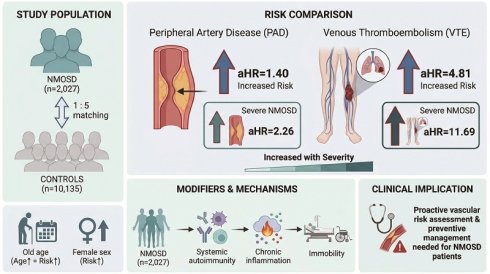
Background: The relationship between Neuromyelitis optica spectrum disorder (NMOSD) and specific cardiovascular outcomes, particularly macrovascular events such as peripheral artery disease (PAD) and venous thromboembolism (VTE), has not been examined in a population-based study. The current study investigated the association between NMOSD and the risks of PAD and VTE.
Materials and Methods: This retrospective cohort study used data from the Taiwan National Health Insurance Research Database. Patients with new-onset NMOSD between 2003 and 2020. Patients with previous PAD or VTE were excluded. Each patient was matched to five general patients for comparison using propensity score matching. In total, the study included 2,027 patients with NMOSD and 10,135 matched general population controls. A Cox proportional hazards model was used to investigate PAD and VTE risk, with relevant variables controlled for. NMOSD was stratified by severity to further verify the association between disease severity and macrovascular event risk. The control variables considered in this study were sex, age, insured salary, urbanization, Charlson comorbidity index (CCI), and related comorbidities.
Results: The average follow-up of all participants was 7.01 person-years. After adjustments for relevant variables, patients with NMOSD had significantly higher risks of PAD (adjusted hazard ratio [aHR] = 1.40; 95% confidence interval [CI]: 1.02-1.92) and VTE (aHR = 4.81; 95% CI: 3.08-7.52). The risk of vascular events was strongly associated with disease severity. Severe NMOSD was associated with markedly increased risks of PAD (aHR = 2.26; 95% CI: 1.41-3.61) and VTE (aHR = 11.69; 95% CI: 6.86-19.90), whereas mild and moderate disease did not significantly increase PAD risk.
Conclusion: NMOSD is a significant risk factor for PAD and VTE. These findings highlight the importance of proactive vascular risk assessment and preventive management in patients with NMOSD.
Keywords: neuromyelitis optic spectrum disorder, peripheral artery disease, venous thromboembolism
Introduction
Neuromyelitis optica spectrum disorder (NMOSD), previously known as Devic's disease, is a rare autoimmune astrocytopathy of the central nervous system, and its prevalence is 0.5-4.4 per 100,000 individuals [1, 2]. The disorder is characterized by recurrent inflammatory attacks mediated by pathogenic autoantibodies that primarily target aquaporin-4 (AQP4) water channels on astrocytic foot processes. This immune response leads to complement-dependent astrocytic injury, blood-brain barrier disruption, and subsequent demyelination and axonal loss [3-5]. Emerging evidence further indicates that AQP4-IgG-mediated complement activation [6] not only damages astrocytes but also amplifies perivascular inflammation and recruits granulocytes, thereby extending injury beyond the central nervous system microenvironment [7]. NMOSD most frequently affects the optic nerves and spinal cord, presenting as recurrent optic neuritis and longitudinally extensive transverse myelitis. Additional core features include area postrema syndrome and involvement of the brainstem, diencephalon, and cerebrum [1, 2, 4].
In addition to its neurological manifestations, NMOSD may increase the risk of thromboembolic events through autoimmune and immobility-related pathways. Systemic autoimmune activity and chronic inflammation can trigger endothelial activation and prothrombotic changes, including increased tissue factor expression, elevated plasminogen activator inhibitor-1 levels, impaired protein C anticoagulant activity, and complement-mediated endothelial injury, all of which promote hypercoagulability [8-12]. Recent studies also suggest that inflammatory cytokine cascades and neutrophil extracellular trap (NET) formation may further potentiate coagulation activation and endothelial dysfunction in NMOSD, providing a more integrated immunothrombotic framework [7, 13]. Moreover, neurological disability and recurrent relapses often lead to hospitalization and reduced mobility, creating venous stasis and further increasing the risk of VTE in patients with NMOSD [8, 9].
Autoimmune diseases such as systemic lupus erythematosus (SLE), inflammatory bowel disease (IBD), and Behçet's syndrome are strongly associated with VTE, which underscores the broader vascular effects of immune-mediated inflammation [10-12]. Persistent inflammation and complement activation may also contribute to arterial injury and atherosclerotic progression, suggesting a mechanistic link between NMOSD and peripheral arterial disease (PAD) [14]. In particular, chronic immune-mediated endothelial injury, oxidative stress, and dysregulated vascular repair mechanisms have been implicated in accelerating atherosclerosis in autoimmune conditions, which may extend to NMOSD despite limited direct evidence [13]. Although studies have reported that coexisting autoimmune diseases are frequently observed in patients with NMOSD [15-17], direct epidemiological evidence quantifying thromboembolic risk in NMOSD remains limited. In particular, the association between NMOSD and PAD has not been systematically evaluated. Furthermore, current literature has primarily focused on venous thromboembolism, while the potential contribution of NMOSD-related immune dysregulation to arterial pathology remains underexplored, highlighting a critical knowledge gap [7, 13]. Therefore, this cohort study used the Taiwan National Health Insurance Research Database (NHIRD) to examine the risks of VTE and PAD in patients with NMOSD and determine whether NMOSD independently contributes to macrovascular complications beyond conventional risk factors.
Materials and Methods
Data Source
This study conducted a secondary analysis by using data from the NHIRD for the period between 2002 and 2022. The NHIRD, managed by Taiwan's Health and Welfare Data Science Center (HWDC), is a comprehensive population-based database that contains outpatient and inpatient medical records for beneficiaries of the National Health Insurance (NHI) program. To ensure confidentiality, the HWDC replaces all personal identifiers with encrypted, randomly generated codes. The NHI was launched in 1995, and it currently provides health coverage to nearly 99% of Taiwan's residents. The NHIRD is therefore widely used as a real-world data source for clinical research and health policy studies [18, 19]. In the NHIRD, diseases were coded in accordance with the International Classification of Diseases, Ninth Revision, Clinical Modification (ICD-9-CM) system before 2016, and subsequently, they were coded using the International Classification of Diseases, Tenth Revision, Clinical Modification (ICD-10-CM) system.
Ethics Statements
For this study, all data were fully anonymized to protect the privacy of beneficiaries, and informed consent was not required because the dataset contained only deidentified information. The research was conducted in compliance with the principles of the Declaration of Helsinki and followed the STROCSS reporting guidelines. Ethical approval for the study protocol was obtained from the Institutional Review Board of Chung Shan Medical University Hospital, Taiwan (CSMUH CS1-24227).
Study Participants
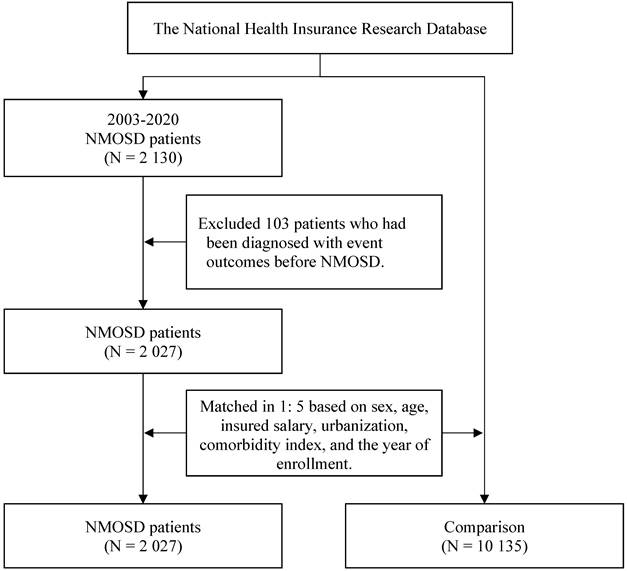
This study identified patients with a new diagnosis of NMOSD between 2003 and 2020. The case definition for NMOSD (ICD-9-CM 341.0; ICD-10-CM G36.0) required at least three outpatient visits with an NMOSD diagnosis within 1 year. Patients with a previous diagnosis of PAD or VTE recorded before the diagnosis of NMOSD were excluded. To reduce selection bias arising from imbalanced covariates in observational studies, we conducted propensity score matching at a 1:5 ratio. Propensity scores were estimated using logistic regression, and a probability value was generated for each patient with NMOSD on the basis of their individual characteristics. This approach enabled balanced comparisons and reduced confounding. The matched variables included sex, age, insured salary, urbanization level, Charlson comorbidity index (CCI), and year of cohort entry. After matching, the study included 2,027 patients with NMOSD and 10,135 matched general population controls. The patient selection process is presented in Figure 1.
The flowchart of participant selection. Abbreviation: NMOSD, neuromyelitis optica spectrum disorder.
Study Design
In this retrospective cohort study, we defined the incidence of PAD (ICD-9-CM 443.9; ICD-10-CM I73.9) and VTE based on at least one inpatient diagnosis or three or more outpatient diagnosis. VTE was identified through codes for deep venous thrombosis (DVT; ICD-9-CM 453.4; ICD-10-CM I82.4) and pulmonary embolism (PE; ICD-9-CM 415.1; ICD-10-CM I26). For the NMOSD group, follow-up began on the date of diagnosis. Matched controls were assigned the same index date as their corresponding NMOSD cases. Each participant was followed from the index date until death, a new diagnosis of PAD or VTE, or the study endpoint in 2022, whichever occurred first. The analysis also accounted for comorbidities, including hypertension (ICD-9-CM 401-405; ICD-10-CM I10-I13 and I15), diabetes mellitus (ICD-9-CM 250; ICD-10-CM E08-E13), hyperlipidemia (ICD-9-CM 272; ICD-10-CM E78), anxiety (ICD-9-CM 300.0; ICD-10-CM F40-F41), and sleep disturbance (ICD-9-CM 780; ICD-10-CM G47.9). These comorbidities were identified via the outpatient and inpatient diagnoses of each participant in the year before the index date.
Statistical Analysis
All statistical analyses were conducted using SAS software, version 9.4 (SAS Institute, Cary, NC, USA). A p value of <0.05 was considered significant. The standardized mean differences were used to compare the distribution differences of baseline characteristics between the NMOSD and control groups. A standardized mean difference of <0.1 was regarded as negligible. A Cox proportional hazards model was used to investigate the risks of PAD and VTE in patients with NMOSD after adjustment for all relevant variables. The results are presented as hazard ratios (HRs) with 95% confidence intervals (CIs). To ensure the validity of the Cox proportional-hazards model, we tested the proportional hazards assumption using graphical assessment (log-log plots) and found no significant violations. Furthermore, to account for the potential confounding effect of death during the long-term follow-up, competing risk analyses were conducted to estimate the hazard ratios for PAD and VTE events. A subgroup analysis was performed to examine the association between NMOSD severity and the risks of PAD and VTE. NMOSD severity was measured as the proportion of total hospital stay attributable to NMOSD during the follow-up period divided by the complete follow-up duration. NMOSD severity was categorized as mild (first tertile), moderate (second tertile) and severe (third tertile). Furthermore, stratified analyses by sex and age were performed to evaluate the consistency of the association between NMOSD and the risks of PAD and VTE across different clinical subgroups.
Results
A total of 12,162 individuals were enrolled in the study, including 2,027 patients with NMOSD and 10,135 matched controls. Table 1 summarizes their baseline characteristics. The NMOSD cohort had a higher proportion of female (73.5%; n = 1,490). The mean ages of the patients in the NMOSD and control cohorts were 43.46 ± 16.42 and 45.74 ± 20.23 years, respectively. The patient with NMOSD and matched controls were well balanced in terms of sex, age, insured salary, urbanization level, and CCI score, as evidenced by standardized mean differences all being less than 0.1. However, the patients with NMOSD had higher prevalences of hyperlipidemia (8.44% vs. 5.18%), anxiety (9.47% vs. 4.28%), and sleep disturbance (14.16% vs. 7.58%) than did the matched controls.
Distribution of baseline characteristics after matching.
| Variables | Total | Comparison | NMOSD b | SMD b | |||
|---|---|---|---|---|---|---|---|
| N | % | N | % | N | % | ||
| Total | 12,162 | 100.00 | 10,135 | 100.00 | 2,027 | 100.00 | |
| Sex a | |||||||
| Female | 8,942 | 73.52 | 7,452 | 73.53 | 1,490 | 73.51 | 0.000 |
| Male | 3,220 | 26.48 | 2,683 | 26.47 | 537 | 26.49 | 0.000 |
| Age (year) a | |||||||
| <25 | 1,742 | 14.32 | 1,460 | 14.41 | 282 | 13.91 | -0.014 |
| 25-34 | 2,083 | 17.13 | 1,736 | 17.13 | 347 | 17.12 | 0.000 |
| 35-44 | 2,944 | 24.21 | 2,454 | 24.21 | 490 | 24.17 | -0.001 |
| ≥45 | 5,393 | 44.34 | 4,485 | 44.25 | 908 | 44.80 | 0.011 |
| Mean ± SD | 45.36 ± 19.66 | 45.74 ± 20.23 | 43.46 ± 16.42 | ||||
| Insured salary (NTD) a | |||||||
| ≤21,000 | 3,266 | 26.85 | 2,722 | 26.86 | 544 | 26.84 | 0.000 |
| 21,001-24,000 | 3,254 | 26.76 | 2,712 | 26.76 | 542 | 26.74 | 0.000 |
| 24,001-40,100 | 2,752 | 22.63 | 2,295 | 22.64 | 457 | 22.55 | -0.002 |
| ≥40,001 | 2,890 | 23.76 | 2,406 | 23.74 | 484 | 23.88 | 0.003 |
| Urbanization a | |||||||
| High | 7,987 | 65.67 | 6,645 | 65.56 | 1,342 | 66.21 | 0.014 |
| Medium | 3,404 | 27.99 | 2,845 | 28.07 | 559 | 27.58 | -0.011 |
| Low | 771 | 6.34 | 645 | 6.36 | 126 | 6.22 | -0.006 |
| CCI score a, b | |||||||
| 0 | 5,084 | 41.80 | 4,230 | 41.74 | 854 | 42.13 | 0.008 |
| 1 | 2,771 | 22.78 | 2,315 | 22.84 | 456 | 22.50 | -0.008 |
| ≥2 | 4,307 | 35.41 | 3,590 | 35.42 | 717 | 35.37 | -0.001 |
| Year of inclusion | |||||||
| 2003 | 186 | 1.53 | 155 | 1.53 | 31 | 1.53 | 0.000 |
| 2004 | 126 | 1.04 | 105 | 1.04 | 21 | 1.04 | 0.000 |
| 2005 | 174 | 1.43 | 145 | 1.43 | 29 | 1.43 | 0.000 |
| 2006 | 102 | 0.84 | 85 | 0.84 | 17 | 0.84 | 0.000 |
| 2007 | 174 | 1.43 | 145 | 1.43 | 29 | 1.43 | 0.000 |
| 2008 | 216 | 1.78 | 180 | 1.78 | 36 | 1.78 | 0.000 |
| 2009 | 402 | 3.31 | 335 | 3.31 | 67 | 3.31 | 0.000 |
| 2010 | 444 | 3.65 | 370 | 3.65 | 74 | 3.65 | 0.000 |
| 2011 | 462 | 3.80 | 385 | 3.80 | 77 | 3.80 | 0.000 |
| 2012 | 738 | 6.07 | 615 | 6.07 | 123 | 6.07 | 0.000 |
| 2013 | 840 | 6.91 | 700 | 6.91 | 140 | 6.91 | 0.000 |
| 2014 | 972 | 7.99 | 810 | 7.99 | 162 | 7.99 | 0.000 |
| 2015 | 1,008 | 8.29 | 840 | 8.29 | 168 | 8.29 | 0.000 |
| 2016 | 1,182 | 9.72 | 985 | 9.72 | 197 | 9.72 | 0.000 |
| 2017 | 1,236 | 10.16 | 1,030 | 10.16 | 206 | 10.16 | 0.000 |
| 2018 | 1,212 | 9.97 | 1,010 | 9.97 | 202 | 9.97 | 0.000 |
| 2019 | 1,374 | 11.30 | 1,145 | 11.30 | 229 | 11.30 | 0.000 |
| 2020 | 1,314 | 10.80 | 1,095 | 10.80 | 219 | 10.80 | 0.000 |
| Comorbidities | |||||||
| Hypertension | |||||||
| No | 10,355 | 85.14 | 8,640 | 85.25 | 1,715 | 84.61 | -0.018 |
| Yes | 1,807 | 14.86 | 1,495 | 14.75 | 312 | 15.39 | 0.018 |
| Diabetes mellitus | |||||||
| No | 10,634 | 87.44 | 8,790 | 86.73 | 1,844 | 90.97 | 0.135 |
| Yes | 1,528 | 12.56 | 1,345 | 13.27 | 183 | 9.03 | -0.135 |
| Hyperlipidemia | |||||||
| No | 11,466 | 94.28 | 9,610 | 94.82 | 1,856 | 91.56 | -0.130 |
| Yes | 696 | 5.72 | 525 | 5.18 | 171 | 8.44 | 0.130 |
| Anxiety | |||||||
| No | 11,536 | 94.85 | 9,701 | 95.72 | 1,835 | 90.53 | -0.206 |
| Yes | 626 | 5.15 | 434 | 4.28 | 192 | 9.47 | 0.206 |
| Sleep disturbance | |||||||
| No | 11,107 | 91.33 | 9,367 | 92.42 | 1,740 | 85.84 | -0.213 |
| Yes | 1,055 | 8.67 | 768 | 7.58 | 287 | 14.16 | 0.213 |
a Matching variable.
b Abbreviation: NMOSD, neuromyelitis optica spectrum disorder; SMD, standardized mean difference; CCI, Charlson comorbidity index.
Table 2 presents the incidence of PAD in the patients with NMOSD and matched controls. During follow-up, the cumulative incidence of PAD in the NMOSD group was 2.52%, which was higher than the rate of 1.77% observed in the controls. The incidence rate of PAD was 3.77 per 1,000 person-years in the NMOSD group and 2.50 per 1,000 person-years in the control group. In the multivariable Cox regression analysis, NMOSD was independently associated with an increased risk of PAD (adjusted HR [aHR] = 1.40; 95% CI = 1.02-1.92). The competing risk analysis also revealed that the NMOSD group had a higher risk of incident PAD (aHR = 1.27; 95% CI = 1.01-1.79). The sex-specific incidence rates of PAD were 2.87 and 2.22 per 1,000 person-years in female and male, respectively. Sex was not a significant predictor of PAD (male vs. female, aHR = 0.84; 95% CI = 0.61-1.15). Age was a significant predictor of PAD; a higher risk of PAD was observed among individuals aged 35-44 years (aHR = 2.81; 95% CI = 1.25-6.28) and those aged ≥45 years (aHR = 5.61; 95% CI = 2.59-12.15).
The incidence rate and risk of incident peripheral artery disease.
| Variables | Peripheral artery disease | |||||
|---|---|---|---|---|---|---|
| Events N | % | Follow-up year | IR a | Adjusted HR (95% CI) | p-value | |
| Total | 230 | 1.89 | 85,213 | 2.70 | ||
| Patient cohort | ||||||
| Comparison | 179 | 1.77 | 71,671 | 2.50 | Reference | |
| NMOSD a | 51 | 2.52 | 13,542 | 3.77 | 1.40 (1.02-1.92) | 0.039 |
| Sex | ||||||
| Female | 181 | 2.02 | 63,159 | 2.87 | Reference | |
| Male | 49 | 1.52 | 22,054 | 2.22 | 0.84 (0.61-1.15) | 0.273 |
| Age (year) | ||||||
| <25 | 7 | 0.40 | 12,856 | 0.54 | Reference | |
| 25-34 | 17 | 0.82 | 16,030 | 1.06 | 1.73 (0.72-4.19) | 0.223 |
| 35-44 | 40 | 1.36 | 22,387 | 1.79 | 2.81 (1.25-6.28) | 0.012 |
| ≥45 | 166 | 3.08 | 33,940 | 4.89 | 5.61 (2.59-12.15) | <0.001 |
| Insured salary (NTD) | ||||||
| ≤21,000 | 86 | 2.63 | 27,815 | 3.09 | Reference | |
| 21,001-24,000 | 56 | 1.72 | 19,472 | 2.88 | 0.82 (0.59-1.16) | 0.271 |
| 24,001-40,100 | 42 | 1.53 | 18,882 | 2.22 | 0.82 (0.56-1.19) | 0.298 |
| ≥40,001 | 46 | 1.59 | 19,044 | 2.42 | 0.77 (0.53-1.11) | 0.158 |
| Urbanization | ||||||
| High | 142 | 1.78 | 55,578 | 2.55 | Reference | |
| Medium | 66 | 1.94 | 23,884 | 2.76 | 1.15 (0.76-1.72) | 0.511 |
| Low | 22 | 2.85 | 5,751 | 3.83 | 1.08 (0.66-1.76) | 0.760 |
| CCI score a | ||||||
| 0 | 45 | 0.89 | 37,225 | 1.21 | Reference | |
| 1 | 64 | 2.31 | 20,506 | 3.12 | 1.81 (1.23-2.67) | 0.003 |
| ≥2 | 121 | 2.81 | 27,482 | 4.40 | 2.00 (1.37-2.91) | <0.001 |
| Comorbidities | ||||||
| Hypertension | 74 | 4.10 | 11,045 | 6.70 | 1.56 (1.16-2.10) | 0.004 |
| Diabetes mellitus | 53 | 3.47 | 9,213 | 5.75 | 1.21 (0.87-1.69) | 0.252 |
| Hyperlipidemia | 24 | 3.45 | 4,525 | 5.30 | 1.07 (0.70-1.65) | 0.750 |
| Anxiety | 33 | 5.27 | 4,490 | 7.35 | 1.92 (1.31-2.81) | <0.001 |
| Sleep disturbance | 59 | 5.59 | 9,482 | 6.22 | 1.98 (1.46-2.70) | <0.001 |
a Abbreviation: IR, incident rate per 1,000 person-year; NMOSD, neuromyelitis optica spectrum disorder; CCI, Charlson comorbidity index.
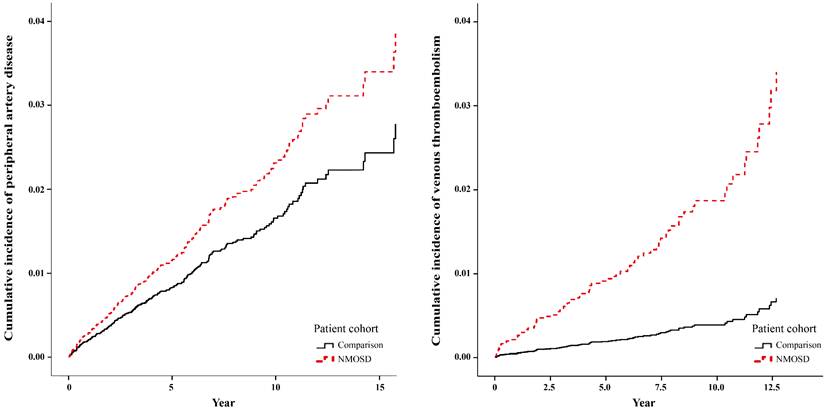
Table 3 presents the incidence of VTE in patients with NMOSD and matched controls. During follow-up, the cumulative incidence of VTE in the NMOSD group was 1.87%, which was higher than the rate of 0.41% observed in the controls. The incidence rate of VTE was 0.28 per 1,000 person-years in the NMOSD group and 0.06 per 1,000 person-years in the control group. The results of the multivariable analysis revealed that NMOSD was strongly associated with a higher risk of VTE (aHR = 4.81; 95% CI = 3.08-7.52). The competing risk analysis also revealed that the NMOSD group had a higher risk of incident VTE (aHR = 4.49; 95% CI = 2.90-6.97). The sex-specific incidence rates were 0.11 and 0.05 per 1,000 person-years for female and male, respectively. In sex-adjusted analysis, male had a lower risk of VTE than did female (aHR = 0.49; 95% CI = 0.26-0.90). The risk of VTE also increased with age, particularly among individuals aged ≥45 years (aHR = 6.17; 95% CI = 1.46-25.98). Figure 2 presents the cumulative incidence curves of PAD and VTE, which reveal a significantly higher incidence in patients with NMOSD than in matched controls (log-rank test, p <0.001).
Cumulative incidence curve of macrovascular events in patients with NMOSD (log-rank test, p <0.001). Abbreviation: NMOSD, neuromyelitis optica spectrum disorder.
The incidence rate and risk of incident venous thromboembolism.
| Variables | Venous thromboembolism | |||||
|---|---|---|---|---|---|---|
| Events N | % | Follow-up year | IR a | adjusted HR (95% CI) | p-value | |
| Total | 80 | 0.66 | 86,129 | 0.09 | ||
| Patient cohort | ||||||
| Comparison | 42 | 0.41 | 72,399 | 0.06 | Reference | |
| NMOSD a | 38 | 1.87 | 13,730 | 0.28 | 4.81 (3.08-7.52) | <0.001 |
| Sex | ||||||
| Female | 68 | 0.76 | 63,889 | 0.11 | Reference | |
| Male | 12 | 0.37 | 22,241 | 0.05 | 0.49 (0.26-0.90) | 0.023 |
| Age (year) | ||||||
| <25 | 3 | 0.06 | 12,886 | 0.16 | Reference | |
| 25-34 | 9 | 0.28 | 16,098 | 0.56 | 2.95 (0.63-13.74) | 0.169 |
| 35-44 | 15 | 0.55 | 22,577 | 0.66 | 3.48 (0.79-15.30) | 0.099 |
| ≥45 | 53 | 1.00 | 34,568 | 0.16 | 6.17 (1.46-25.98) | 0.013 |
| Insured salary (NTD) | ||||||
| ≤21,000 | 24 | 0.73 | 28,260 | 0.09 | Reference | |
| 21,001-24,000 | 23 | 0.71 | 19,603 | 0.12 | 1.42 (0.79-2.55) | 0.244 |
| 24,001-40,100 | 18 | 0.65 | 19,037 | 0.10 | 1.19 (0.64-2.23) | 0.578 |
| ≥40,001 | 15 | 0.52 | 19,229 | 0.08 | 0.89 (0.46-1.71) | 0.724 |
| Urbanization | ||||||
| High | 52 | 0.65 | 56,165 | 0.93 | Reference | |
| Medium | 23 | 0.68 | 24,120 | 0.95 | 1.22 (0.60-2.55) | 0.208 |
| Low | 5 | 0.65 | 5,844 | 0.86 | 1.02 (0.38-2.79) | 0.964 |
| CCI score a | ||||||
| 0 | 18 | 0.35 | 37,388 | 0.05 | Reference | |
| 1 | 18 | 0.65 | 20,757 | 0.09 | 1.46 (0.75-2.85) | 0.261 |
| ≥2 | 44 | 1.02 | 27,985 | 0.16 | 2.27 (1.25-4.13) | 0.007 |
| Comorbidities | ||||||
| Hypertension | 25 | 1.38 | 11,382 | 0.22 | 1.70 (1.01-2.84) | 0.045 |
| Diabetes mellitus | 16 | 1.05 | 9,384 | 0.17 | 1.14 (0.63-2.07) | 0.657 |
| Hyperlipidemia | 10 | 1.44 | 4,602 | 0.22 | 1.32 (0.67-2.59) | 0.430 |
| Anxiety | 8 | 1.28 | 4,664 | 0.17 | 1.07 (0.51-2.26) | 0.852 |
| Sleep disturbance | 16 | 1.52 | 9,844 | 0.16 | 1.18 (0.67-2.09) | 0.563 |
a Abbreviation: IR, incident rate per 1,000 person-year; NMOSD, neuromyelitis optica spectrum disorder; CCI, Charlson comorbidity index.
Table 4 presents the findings of subgroup analysis stratified by NMOSD severity. The risk of PAD was significantly higher in the severe NMOSD subgroup (aHR = 2.26; 95% CI = 1.41-3.61), whereas the mild (aHR = 1.50; 95% CI = 0.99-2.27) and moderate subgroups (aHR = 0.49; 95% CI = 0.20-1.19) did not demonstrate a significant increase in the risk of PAD. For VTE, including deep venous thrombosis (DVT) and pulmonary embolism (PE), both the moderate and severe NMOSD subgroups exhibited substantially elevated risks compared with controls, indicating that increasing disease severity is strongly associated with higher VTE incidence. The results of the stratified analysis are presented in Table 5. In terms of PAD, the increased risk associated with NMOSD was particularly prominent and statistically significant in male patients (aHR = 1.97; 95% CI = 1.04-3.74). Although higher aHRs were observed in younger age groups (e.g., <45 years), these did not reach statistical significance. For VTE, NMOSD was associated with a significantly higher risk across most subgroups. Notably, female with NMOSD exhibited a more than 5-fold increase in VTE risk compared to the comparison group (aHR = 5.21; 95% CI = 3.21-8.46). When stratified by age, the risk of VTE was substantially elevated in all groups aged 25 and older, with the highest magnitude observed in the 35-44 years age group (aHR = 9.01; 95% CI = 3.01-26.97).
Subgroup analysis by the severity of neuromyelitis optica spectrum disorder.
| Variables | Peripheral artery disease | Venous thromboembolism | ||||||
|---|---|---|---|---|---|---|---|---|
| Overall | Deep venous thrombosis | Pulmonary embolism | ||||||
| aHR (95% CI) a | p-value | aHR (95% CI) a | p-value | aHR (95% CI) a | p-value | aHR (95% CI) a | p-value | |
| NMOSD cohort | 1.40 (1.02-1.92) | 0.039 | 4.81 (3.08-7.52) | <0.001 | 8.22 (4.55-14.88) | <0.001 | 2.29 (1.10-4.77) | 0.027 |
| By the total length of hospital stay | ||||||||
| Mild | 1.50 (0.99-2.27) | 0.058 | 1.31 (0.51-3.32) | 0.574 | 1.76 (0.52-5.97) | 0.367 | 0.90 (0.21-3.85) | 0.882 |
| Moderate | 0.49 (0.20-1.19) | 0.116 | 5.05 (2.58-9.87) | <0.001 | 7.64 (3.17-18.42) | <0.001 | 3.78 (1.42-10.06) | 0.008 |
| Severe | 2.26 (1.41-3.61) | <0.001 | 11.69 (6.86-19.90) | <0.001 | 23.83 (12.20-46.51) | <0.001 | 3.13 (1.06-9.20) | 0.038 |
a aHR, adjusted hazard ratio. Adjustment for sex, age, insured salary, urbanization, CCI score, and all comorbidities.
Stratified analysis of the risk of peripheral artery disease and venous thromboembolism.
| Variables | NMOSD a vs Comparison (ref.) | ||||
|---|---|---|---|---|---|
| Adjusted HR b | 95% CI | p-value | |||
| Peripheral artery disease | |||||
| Sex | |||||
| Female | 1.25 | 0.86 | - | 1.81 | 0.244 |
| Male | 1.97 | 1.04 | - | 3.74 | 0.039 |
| Age (year) | |||||
| <25 | 2.24 | 0.41 | - | 12.36 | 0.354 |
| 25-34 | 2.55 | 0.89 | - | 7.31 | 0.081 |
| 35-44 | 1.85 | 0.92 | - | 3.73 | 0.086 |
| ≥45 | 1.17 | 0.79 | - | 1.74 | 0.436 |
| Venous thromboembolism | |||||
| Sex | |||||
| Female | 5.21 | 3.21 | - | 8.46 | <0.001 |
| Male | 2.80 | 0.84 | - | 9.33 | 0.093 |
| Age (year) | |||||
| <25 | - | - | - | ||
| 25-34 | 7.98 | 1.52 | - | 41.85 | 0.014 |
| 35-44 | 9.01 | 3.01 | - | 26.97 | <0.001 |
| ≥45 | 3.51 | 2.01 | - | 6.12 | <0.001 |
a Abbreviation: NMOSD, neuromyelitis optica spectrum disorder.
b The adjustment variables contained sex, age, insured salary, urbanization, CCI score, and related comorbidities.
Discussion
In this population-based cohort study, patients with NMOSD had higher risks of both PAD and VTE, including DVT and PE. The risk of DVT was particularly high in these patients. Older age further increased the risks of PAD and VTE. In addition, disease severity affected outcomes: the severe NMOSD subgroup had the highest risk of PAD, whereas the moderate and severe NMOSD subgroups had a high risk of VTE. Furthermore, male had a significantly lower risk of VTE than did female.
The increased thromboembolic risk in NMOSD may be related to the combined effects of systemic autoimmune activity and neurological disability. Specifically, it has been proposed that inflammatory responses in NMOSD can disrupt vascular integrity and alter coagulation pathways, creating a prothrombotic environment [8, 9]. From a systemic immunopathological perspective, NMOSD is characterized by AQP4-IgG-mediated inflammatory cascades accompanied by peripheral immune dysregulation, including cytokine release and immune cell alterations, which play a central role in disease progression [7, 20]. Rather than being confined to the central nervous system, these immune processes may also contribute to endothelial dysfunction and coagulation imbalance.
In particular, proinflammatory cytokines and activated innate immune cells have been implicated as key mediators of disease activity [20], and may simultaneously promote a prothrombotic milieu. Circulating inflammatory markers such as neutrophil-to-lymphocyte ratio (NLR) and platelet-to-lymphocyte ratio (PLR), which are associated with disease activity and relapse in NMOSD, may further reflect this sustained systemic inflammatory state [7]. Moreover, recurrent relapses often necessitate hospitalization, and the resulting periods of reduced mobility promote venous stasis, thereby increasing the risk of VTE [8, 9].
Autoimmune disorders are well-established risk factors for VTE. Conditions such as SLE, IBD, and Behçet's syndrome are associated with an increased risk of VTE [10]. Several studies have expanded on this, demonstrating that a wide range of autoimmune and immune-mediated diseases are associated with increased risks of both PE and VTE [9-12]. Notably, sex-related differences have also been observed among autoimmune conditions. Unlike immune-mediated conditions such as coeliac disease and Hashimoto's thyroiditis, in which male have a disproportionately higher risk of VTE, as indicated by our findings, male patients with NMOSD have a significantly lower risk of VTE than female patients with NMOSD do [21]. Several mechanisms have been proposed to explain this association, including chronic systemic inflammation, increased tissue factor expression, elevated plasminogen activator inhibitor-1 levels, and impaired protein C anticoagulant activity; all of these contribute to a prothrombotic state [12]. These processes may be further potentiated by persistent endothelial dysfunction, which has been increasingly recognized as a central mediator linking inflammation and thrombosis in autoimmune diseases. Additionally, emerging evidence suggests that systemic inflammatory markers, such as elevated neutrophil-to-lymphocyte ratio and increased B-cell activity, are associated with disease activity and may indirectly reflect a prothrombotic state in NMOSD [13]. Furthermore, hospitalization is a risk factor because individuals admitted for autoimmune or immune-mediated disorders are more likely to develop subsequent VTE [12, 21].
With respect to PAD, our results suggest a possible association between NMOSD and an increased risk of PAD. Rather than a direct disease-specific effect, this association may reflect cumulative vascular injury driven by chronic inflammation, endothelial dysfunction, and impaired vascular repair, which are known contributors to atherosclerotic progression in systemic autoimmune conditions [13]. In addition, our analysis identified hypertension and depression as significant comorbid factors associated with PAD risk in NMOSD. This finding may be explained by the persistent systemic inflammatory milieu characteristic of NMOSD, as evidenced by elevated peripheral inflammatory markers such as C-reactive protein and neutrophil-to-lymphocyte ratio, which have also been implicated in atherosclerotic progression [7, 22, 23]. Furthermore, inflammatory activity reflected by markers such as NLR and B-cell activation has been shown to correlate with disease severity and relapse in NMOSD, suggesting a sustained inflammatory burden that may potentiate vascular injury [13, 23]. Within this context, the coexistence of hypertension and depression may further amplify inflammation-mediated endothelial dysfunction, thereby contributing to PAD development. This observation is partially consistent with previous findings indicating that cardiovascular conditions in MS, NMOSD, and transverse myelitis are as common as they are in the general population, indicating a need for more detailed characterization of the vascular risks in these diseases [14]. Taken together, these findings suggest a potential mechanistic link between chronic inflammation and vascular injury in NMOSD; however, direct mechanistic evidence in NMOSD remains limited, and further studies are warranted to elucidate the underlying pathophysiological mechanisms.
Our findings reveal a significantly higher incidence of VTE in the patients with NMOSD than in the control population. This finding is consistent with that of a previous study indicating that patients NMOSD may have an increased risk of VTE [24]. From a mechanistic perspective, in addition to neurologic disability leading to venous stasis, autoimmune and inflammatory mechanisms may contribute to hypercoagulability and elevated VTE risk in NMOSD [24]. Importantly, these mechanisms are likely synergistic, with systemic inflammation enhancing coagulation activation while endothelial injury reduces antithrombotic capacity, thereby lowering the threshold for thrombosis [7, 13]. Such interactions may reflect an integrated immunothrombotic process rather than isolated pathological pathways [25]. In this study, analysis revealed a positive correlation between VTE incidence and increasing age, suggesting that both NMOSD-related factors and age-associated conditions contribute to the increased VTE risk.
We observed that the risks of both DVT and PE—together constituting VTE [10]—were significantly higher in the patients with NMOSD than in the general population, with DVT contributing most prominently to this increase. Consistent with our findings, previous studies have reported that VTE is a common complication in NMOSD, especially among individuals with TM [25]. In addition, VTE occurred in 12.0% of patients with NMOSD during acute attacks in our cohort, which closely aligns with a previously reported rate of 10.9% [24]. This temporal association with acute disease activity further supports the role of inflammation-driven thrombogenicity. These results highlight the increased susceptibility of patients with NMOSD to severe thrombotic events.
On the other hand, we determined that patients with NMOSD had an increased risk of PAD, with this particularly true for those aged ≥45 years. However, the current analysis did not demonstrate a significant association between female sex and a higher PAD risk. Given these inconsistencies, further investigation is warranted to clarify the nature and strength of this association.
We observed that patients with NMOSD had an increased risk of VTE, which is consistent with previous evidence indicating that cardiovascular and treatment-related factors contribute to thrombotic complications in this population [24]. The risk of VTE was also significantly higher among individuals aged ≥45 years; this finding is consistent with that of a previous study indicating that advanced age and prolonged hospitalization are associated with an increased risk of VTE in NMOSD [8]. These results indicate that VTE risk in NMOSD is multifactorial and affected by comorbidities, age, sex, and factors related to treatment or immobilization [24].
We noted that the risk of PAD was associated with NMOSD severity, with the highest risk observed in individuals with severe NMOSD. One possible interpretation is that greater disease severity reflects a higher cumulative inflammatory burden, which may accelerate vascular remodeling and atherosclerotic processes over time [13]. Given that cardiovascular comorbidities and related risk factors are common and associated with poor outcomes in demyelinating disorders such as myelin oligodendrocyte glycoprotein antibody-associated disease and double seronegative NMOSD [26], our findings suggest that patients with NMOSD have a different risk profile outside the inpatient setting. Moreover, although hospitalized patients with NMOSD generally have prolonged lengths of stay compared with nonhospitalized patients [6], PAD risk did not appear to be disproportionately elevated in this subgroup.
Existing research suggests that NLR and PLR are significantly correlated with NMOSD severity and pathophysiology, reflecting systemic immune-inflammatory states with high clinical utility [22, 27, 28]. In this study, NMOSD severity was operationalized using hospitalization duration and categorized into tertiles as a pragmatic proxy, given the absence of standardized clinical measures—such as the Expanded Disability Status Scale (EDSS), relapse frequency, and MRI findings—in the NHIRD. Although hospitalization duration has been used in administrative database research as an indirect indicator of disease burden, it does not fully capture the multidimensional nature of NMOSD severity, including neurological disability progression, subclinical disease activity, and relapse severity. Consequently, misclassification may arise, particularly if hospitalization duration is influenced by non-disease-related factors such as healthcare access, physician practice patterns, or comorbidities. This non-differential misclassification may attenuate true associations and bias subgroup estimates toward the null; therefore, findings from severity-stratified analyses should be interpreted with caution.
We determined that the risk of VTE increased with NMOSD severity, with the highest risk observed in patients with moderate to severe disease. This pattern is consistent with previous evidence indicating that hospitalization for immune-mediated diseases increases the risk of VTE [21]. This gradient of risk supports a model in which thrombotic complications are driven not only by immobilization but also by the intensity of systemic inflammation and its downstream vascular effects. Such findings reinforce the hypothesis that inflammatory burden plays a central role in thrombotic susceptibility in NMOSD [7]. These findings highlight the importance of early identification and proactive management of VTE risk in this vulnerable population.
Our study has several notable strengths. Few studies have examined the relationship between NMOSD and PAD and VTE using HRs. We extend this work by identifying the associated risks, whereas previous studies have primarily focused on their prevalence. We used data from nationwide population-based cohorts in Taiwan, ensuring that our large sample is highly representative and provides strong statistical precision. The NHIRD includes data for nearly the entire Taiwanese population, providing a solid foundation for population-based research. Its comprehensive coverage also helps mitigate selection bias, which is a common drawback in observational studies. Although prospective population-based cohort studies are often preferred for identifying risk factors, our retrospective cohort study, using detailed insurance data available in the NHIRD, can be considered a dependable and effective alternative design.
This study has several limitations that should be acknowledged. First, the dataset did not contain key information on established thromboembolic risk factors in NMOSD, including smoking status, alcohol consumption, body mass index, physical activity, personal medical history, disease activity, and disease duration. Second, in this study, NMOSD severity was proxied by the proportion of total hospital stay, representing the cumulative clinical burden. However, we acknowledge several limitations: disease-specific characteristics such as AQP4 antibody status, precise relapse frequency, and the specific use of immunosuppressive or biologic therapies could not be directly captured. These factors may exert complex effects on systemic inflammation and vascular function. While our severity definition (based on LOS tertiles) serves as a functional surrogate in a nationwide database, the lack of information on treatment exposure and temporal changes in disease activity may introduce residual confounding. Future research with integrated clinical registries is warranted to refine these severity assessments. Furthermore, all diagnoses were identified using ICD-9-CM and ICD-10-CM codes. Although Taiwan's Bureau of National Health Insurance performs random chart audits to maintain coding accuracy, the presence of unmeasured confounders cannot be fully excluded.
Conclusion
NMOSD is associated with a significantly increased risk of both PAD and VTE, with the risk of VTE being particularly elevated. Older age and greater disease severity further contribute to these risks. Notably, in this study, the risk of VTE was significantly higher in hospitalized patients, whereas the risk of PAD was higher among nonhospitalized individuals. Additionally, male patients had a lower risk of VTE than their female counterparts did. These findings underscore the need for timely vascular risk assessment and proactive management in patients with NMOSD.
Acknowledgements
We are grateful to Health Data Science Center, China Medical University Hospital, for providing administrative, technical, and funding support. This study is based, in part, on data released by the Health and Welfare Data Science Center, Ministry of Health and Welfare. The interpretation and conclusions contained herein do not represent those of the Ministry of Health and Welfare.
Funding
This research was funded by the Chung Shan Medical University, Taiwan (CSMU-INT-114-03), China Medical University, Taiwan (CMU114-ASIA-15, CMU114-MF-119), and National Science and Technology Council, Taiwan (NSTC 114-2410-H-039-006-MY3).
Data Availability Statement
Datasets from the National Health Insurance Research Database (NHIRD) were retrieved in this retrospective cohort study, and the data are available from the Taiwan National Health Insurance (NHI) Bureau. The data is not publicly available because of legal restrictions regarding the “Personal Information Protection Act” in Taiwan. However, requests for data can be formally sent to the NHI bureau. (https://dep.mohw.gov.tw/DOS/cp-2516-3591-113.html).
Author Contributions
All the authors involved in drafting or revising the article and approved of the submitted version. Study conception and design: Xin-An, Chen, Chun-Nan Wu, Kuang-Hua Huang and Chien-Ying Lee; Data acquisition: Xin-An, Chen, Chun-Nan Wu, Tung-Han Tsai, and Chien-Yu Lin; Data analysis and demonstration: Hsuan Chang and Shuo-Yan Gau; Validation: Kuang-Hua Huang and Chien-Ying Lee; Writing - original draft: Xin-An, Chen, Chun-Nan Wu, Tung-Han Tsai, Chien-Yu Lin, Hsuan Chang, Shuo-Yan Gau, Kuang-Hua Huang, and Chien-Ying Lee; Writing - review & editing: Xin-An, Chen, Chun-Nan Wu, Tung-Han Tsai, Chien-Yu Lin, Hsuan Chang, Shuo-Yan Gau, Kuang-Hua Huang, and Chien-Ying Lee.
Competing Interests
The authors have declared that no competing interest exists.
References
1. Guo J, Zhang D, Gong Y, Liu J, Zhang J, Zhao Y. Association of retinal microvascular abnormalities and neuromyelitis optica spectrum disorders with optical coherence tomography angiography. Front Neurosci. 2023;17:1194661
2. Zhang X, Xiao H, Liu C, Zhao L, Wang J, Li H. et al. Comparison of macular structural and vascular changes in neuromyelitis optica spectrum disorder and primary open angle glaucoma: a cross-sectional study. Br J Ophthalmol. 2021;105:354-60
3. Lin H, Duan X, Li L, Ye J, Xiao H. Neuromyelitis Optica Spectrum Disorder with Sick Sinus Syndrome: Two Cases and a Literature Review. Healthcare (Basel). 2023 11
4. Ghosh Md R, Roy D, León-Ruiz M, Das S, Dubey S, Benito-León J. Seropositive Neuromyelitis Optica in a Case of Undiagnosed Ankylosing Spondylitis: A Neuro-Rheumatological Conundrum. Qatar Med J. 2022;2022:29
5. Rosenberg GA. Neurological diseases in relation to the blood-brain barrier. J Cereb Blood Flow Metab. 2012;32:1139-51
6. Ajmera MR, Boscoe A, Mauskopf J, Candrilli SD, Levy M. Evaluation of comorbidities and health care resource use among patients with highly active neuromyelitis optica. J Neurol Sci. 2018;384:96-103
7. Wu B, Cao F, Mao M, Gong X, Xu B. Peripheral blood immune inflammatory markers in neuromyelitis optica spectrum disorders. Front Neurol. 2025;16:1690767
8. Farber RS, Gross R, Zakin E, Fabian M. Risk of venous thromboembolism in neuromyelitis optica patients hospitalized for acute relapse. Mult Scler. 2017;23:988-94
9. Yusuf HR, Hooper WC, Grosse SD, Parker CS, Boulet SL, Ortel TL. Risk of venous thromboembolism occurrence among adults with selected autoimmune diseases: a study among a U.S. cohort of commercial insurance enrollees. Thromb Res. 2015;135:50-7
10. Zoller B, Li X, Sundquist J, Sundquist K. Autoimmune diseases and venous thromboembolism: a review of the literature. Am J Cardiovasc Dis. 2012;2:171-83
11. Zoller B, Li X, Sundquist J, Sundquist K. Risk of pulmonary embolism in patients with autoimmune disorders: a nationwide follow-up study from Sweden. Lancet. 2012;379:244-9
12. Yusuf HR, Hooper WC, Beckman MG, Zhang QC, Tsai J, Ortel TL. Risk of venous thromboembolism among hospitalizations of adults with selected autoimmune diseases. J Thromb Thrombolysis. 2014;38:306-13
13. Li H, Jiang Y, Zhang Y, Xu D, Zhang Y. Relapse risk factors analysis within 1 year after the first onset of neuromyelitis optica spectrum disorders: A two-center retrospective study. Mult Scler Relat Disord. 2025;93:106209
14. Saroufim P, Zweig SA, Conway DS, Briggs FBS. Cardiovascular conditions in persons with multiple sclerosis, neuromyelitis optica and transverse myelitis. Mult Scler Relat Disord. 2018;25:21-5
15. Han J, Yang MG, Zhu J, Jin T. Complexity and wide range of neuromyelitis optica spectrum disorders: more than typical manifestations. Neuropsychiatr Dis Treat. 2017;13:2653-60
16. Rosales D, Kister I. Common and Rare Manifestations of Neuromyelitis Optica Spectrum Disorder. Curr Allergy Asthma Rep. 2016;16:42
17. Boussaid S, Rahmouni S, Rekik S, Jammali S, Cheour E, Sahli H. et al. Acute transverse myelitis revealing ankylosing spondylitis: A case report and literature review. Clin Case Rep. 2021;9:e04878
18. Hsieh CY, Su CC, Shao SC, Sung SF, Lin SJ, Kao Yang YH. et al. Taiwan's National Health Insurance Research Database: past and future. Clin Epidemiol. 2019;11:349-58
19. Lai SW, Liao KF, Lin CL, Lin CC, Lin CH. Longitudinal data of multimorbidity and polypharmacy in older adults in Taiwan from 2000 to 2013. Biomedicine (Taipei). 2020;10:1-4
20. Carnero Contentti E, Correale J. Neuromyelitis optica spectrum disorders: from pathophysiology to therapeutic strategies. J Neuroinflammation. 2021;18:208
21. Ramagopalan SV, Wotton CJ, Handel AE, Yeates D, Goldacre MJ. Risk of venous thromboembolism in people admitted to hospital with selected immune-mediated diseases: record-linkage study. BMC Med. 2011;9:1
22. Xie H, Zhao Y, Pan C, Zhang J, Zhou Y, Li Y. et al. Association of neutrophil-to-lymphocyte ratio (NLR) with the prognosis of first attack neuromyelitis optica spectrum disorder (NMOSD): a retrospective cohort study. BMC Neurol. 2021;21:389
23. Cabanillas-Lazo M, Cruzalegui-Bazan C, Pascual-Guevara M, Quispe-Vicuna C, Terry-Escalante FA, Mori N. et al. Clinical and imagenologic significance of the neutrophil-to-lymphocyte ratio in neuromyelitis optica spectrum disorder: A systematic review with meta-analysis. PLoS One. 2023;18:e0281064
24. Pan J, Zhu R, Lin J, Li X, Xia J. Incidence and risk factors for venous thromboembolism during an acute attack in patients with neuromyelitis optica spectrum disorders. Multiple Sclerosis and Related Disorders. 2022;58:103513
25. Farber R, Gross R, Zakin E, Fabian M. Risk of venous thromboembolism in neuromyelitis optica patients hospitalized for acute relapse. Multiple Sclerosis Journal. 2016;23:988-94
26. Samadzadeh S, Oertel FC, Salih H, Lin TY, Motamedi S, Chien C. et al. Comorbidities Are Associated With Unfavorable Outcome in Aquaporin-4 Antibody Positive Neuromyelitis Optica Spectrum Disorders and Myelin Oligodendrocyte Glycoprotein Antibody-Associated Disease: Exploratory Study From the CROCTINO Cohort. Eur J Neurol. 2025;32:e70214
27. Lin J, Xue B, Li J, Xu H, Huang X, Yao Z. et al. Neutrophil to lymphocyte ratio may be a helpful marker to evaluate disease activity in NMOSD. Neurol Sci. 2017;38:1859-63
28. Zhou Y, Xie H, Zhao Y, Zhang J, Li Y, Duan R. et al. Neutrophil-to-Lymphocyte Ratio on Admission is an Independent Risk Factor for the Severity of Neurological Impairment at Disease Onset in Patients with a First Episode of Neuromyelitis Optica Spectrum Disorder. Neuropsychiatr Dis Treat. 2021;17:1493-503
Author contact
Corresponding authors: Chien-Ying Lee, PhD, Department of Pharmacology, Chung Shan Medical University, No.110, Sec.1, Jianguo N.Rd., Taichung City 40201, Taiwan; Tel: 886-4-24730022 #11664; Email: cshd015edu.tw; Kuang-Hua Huang, PhD, Department of Health Services Administration, China Medical University, No. 100, Section 1, Jingmao Rd., Beitun District, Taichung City 406040, Taiwan; Tel: 886-4-22053366 #6310; Email: khhuangcmu.edu.tw.