Impact Factor ISSN: 1449-1907




Int J Med Sci 2026; 23(4):1257-1263. doi:10.7150/ijms.129479 This issue Cite
Research Paper
Association of NUCB2 genetic variants with the clinicopathological features of oral cancer
Chang-Chiang Yu1, Hsueh-Ju Lu2,3, Ming-Yu Lien4,5, Chiao-Wen Lin6,7, Jian-Hong Yu1,8, Shun-Fa Yang9,10  , Chih-Hsin Tang4,11,12,13
1. School of Dentistry, China Medical University, Taichung, Taiwan.
2. School of Medicine, Chung Shan Medical University, Taichung, Taiwan.
3. Division of Hematology and Oncology, Department of Internal Medicine, Chung Shan Medical University Hospital, Taichung, Taiwan.
4. School of Medicine, China Medical University, Taichung, Taiwan.
5. Division of Hematology and Oncology, Department of Internal Medicine, China Medical University Hospital, Taichung, Taiwan.
6. Institute of Oral Sciences, Chung Shan Medical University, Taichung, Taiwan.
7. Department of Dentistry, Chung Shan Medical University Hospital, Taichung, Taiwan.
8. Department of Orthodontics, China Medical University Hospital, Taichung, Taiwan.
9. Institute of Medicine, Chung Shan Medical University, Taichung, Taiwan.
10. Department of Medical Research, Chung Shan Medical University Hospital, Taichung, Taiwan.
11. Department of Pharmacology, School of Medicine, China Medical University, Taichung, Taiwan.
12. Department of Medical Laboratory Science and Biotechnology, Asia University, Taichung, Taiwan.
13. Chinese Medicine Research Center, China Medical University, Taichung, Taiwan.
Received 2025-9-21; Accepted 2026-2-5; Published 2026-2-26
Abstract
Oral cancer ranks as the fourth most common cancer among men in Taiwan and the ninth most common cancer among men worldwide. Nesfatin-1, an adipokine derived from the precursor NUCB2 gene, was originally discovered in hypothalamic neurons. The connections among lifestyle factors that promote cancer, NUCB2 polymorphisms, and oral cancer are still not well understood. We examined the association of four NUCB2 gene polymorphisms (rs1330, rs214101, rs757081, and rs10766383) and clinicopathological characteristics with oral cancer in Taiwanese men compared with healthy controls. According to our data, in patients aged ≥60 years, specific NUCB2 genotypes were significantly associated with more aggressive disease features. Compared with the wild-type C/C genotype, carriage of at least one polymorphic allele (T allele at rs1330 or G allele at rs757081) was correlated with an elevated risk of progression to stage III/IV disease. Furthermore, the GA/AA genotypes at rs214101 and the TG/GG genotypes at rs10766383 were associated with elevated risks of both advanced-stage (III/IV) disease and lymph node metastasis. Our findings suggest that NUCB2 SNPs may play a pivotal role in oral cancer progression and metastatic potential, particularly in older patients.
Keywords: nesfatin-1, NUCB2, oral cancer, genetic polymorphisms
Introduction
One of the key etiological factors of high death rates is oral cancer, which is the most frequent type of head and neck cancer [1]. Oral cancer has emerged as one of the most prevalent malignant tumors worldwide, according to the "Global Cancer Statistics 2022" survey [1]. Of all oral cancers, oral squamous cell carcinoma (OSCC) is the biggest general (representing nearly 90% of all malignancies of the mouth cavity) [2]. Human papillomavirus infection and regular use of carcinogens including alcohol, tobacco, and betel nuts are major risk factors for OSCC [3, 4]. Around 86% of Taiwanese oral cancer patients are frequent betel nut chewers [5, 6]. Oral cancer is also linked with genetic anomalies caused by DNA repair, dysregulation of carcinogen metabolism and cell cycle regulation [7].
Adipokines are bioactive agents secreted by adipose tissue that regulate a range of physiological processes, including inflammation, homeostasis, insulin responsiveness, and immune responses [8]. Metabolic and inflammatory pathways are influenced by key adipokines for instance nesfatin-1, adiponectin, resistin and leptin, which act locally or systemically through endocrine, autocrine, or paracrine processes [9]. Adipokines have multifaceted effects in cancer, impacting the tumor microenvironment, cellular proliferation, apoptosis, angiogenesis, and metastasis [10-12]. Originating from its precursor NUCB2, nesfatin-1 is an 82-amino acid polypeptide that was originally found in hypothalamic neurons [13]. Additionally, peripheral tissues include adipose tissue, the pancreas, the ovaries, the colon, and the duodenum express nesfatin-1 [14]. Multifaceted roles have been related with nesfatin-1 and it is documented as an anorexigenic peptide having antihyperglycemic, anti-inflammatory and antioxidant functions [15, 16]. Recently, investigations have found elevated NUCB2 expression in colon, breast, endometrial, thyroid, and prostate cancers [17]. These data reveal a clear link between nesfatin-1 level and poor prognosis, with the development of metastasis and reduced disease-free survival.
A change in a single nucleotide that takes place at a particular position in the genome is known as a single nucleotide polymorphism (SNP) [18]. SNP distribution frequency comparisons between patient populations are commonly applied to estimate the prognosis and risk of diseases, including cancer [19, 20]. No data are available on the links between carcinogenic lifestyle factors, NUCB2 gene polymorphisms, and oral cancer. Consequently, this research investigated the impact of carcinogenic lifestyle factors and NUCB2 gene polymorphisms on the likelihood of oral cancer development in a cohort of Taiwanese. We also investigated the relationships between NUCB2 genotypes and the histopathological prognostic variables of oral cancer.
Materials and Methods
Study participants
We registered 1161 patients with oral cancer at Chung Shan Medical University Hospital in Taiwan. From the Taiwan Biobank Project, 1186 healthy controls (HCs) with no cancer history were randomly chosen and anonymized. Demographic data and carcinogenic lifestyle practices (alcohol use, cigarette smoking, betel nut chewing) were recorded. Daily smokers were defined as those who had smoked at least one cigarette per day for the three months prior. Alcohol consumers were defined as those who, on average, drank more than two alcoholic beverages per day. Oral cancer was assessed using the 2018 American Joint Committee on Cancer (AJCC) Cancer Staging Manual [21]. A pathologist used the AJCC classification standards to evaluate tumor cell differentiation. Every method employed in the research involving human beings complied with the Declaration of Helsinki's standards. After gaining access to the data, each author reviewed and approved the study. The Chung Shan Medical University Hospital's Institutional Review Board approved the study before to its start.
Selection and genotyping of SNPs
The NUCB2 SNPs rs1330, rs214101, rs757081 and rs10766383 were selected based on previous reports [22, 23]. Every SNP had a minor allele frequency greater than 5%. Genomic DNA was extracted from 3 mL peripheral blood samples using QIAamp DNA Blood Kits (Qiagen, CA, USA). Using previously described assessment techniques [8, 20, 21], allelic discrimination was performed on the SNPs. RT-qPCR experiments and the isolation of RNA were performed following the protocols we published earlier [24, 25].
Statistical analysis
To assess the differences between the oral cancer and control groups, the Fisher's exact test and Mann-Whitney U test were employed, with p-values below 0.05 considered statistically significant. Logistic regression was used to calculate odds ratios (ORs) and their 95% confidence intervals (CIs) for the associations between genotype frequencies and oral cancer risk. The collected data were analyzed using version 9.1 of the Statistical Analytic System (SAS) software.
Results
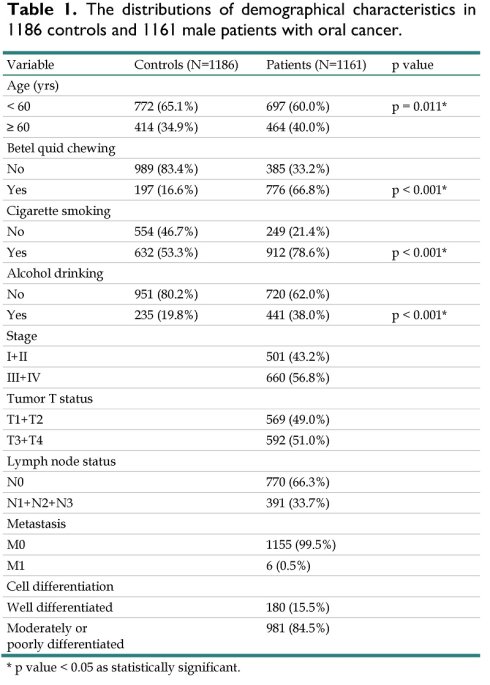
Table 1 shows the distribution of demographic and clinical characteristics in 1161 cancer-free HCs and 1,186 male patients with oral cancer. The percentage of patients aged ≥ 60 years was markedly higher in the oral cancer group (40.0%, n=464) than in the control group (34.9%, n=414) (p = 0.011). Controls reported betel quid chewing (p < 0.001), cigarette smoking (p < 0.001), and alcohol consumption (p < 0.001) markedly less frequently than the oral cancer patients (Table 1). The proportions of patients classified as T1/T2 or T3/T4 tumor status were similar. Regarding lymph node status, 66.3% of patients had N0 status, while 33.7% had N1-N3 status. The vast majority (99.5%) of patients were without distant metastasis (M0). Furthermore, 84.5% of patients had moderately or poorly differentiated oral cancer, compared to 15.5% with well-differentiated disease (Table 1).
The distributions of demographical characteristics in 1186 controls and 1161 male patients with oral cancer.
| Variable | Controls (N=1186) | Patients (N=1161) | p value |
|---|---|---|---|
| Age (yrs) | |||
| < 60 | 772 (65.1%) | 697 (60.0%) | p = 0.011* |
| ≥ 60 | 414 (34.9%) | 464 (40.0%) | |
| Betel quid chewing | |||
| No | 989 (83.4%) | 385 (33.2%) | |
| Yes | 197 (16.6%) | 776 (66.8%) | p < 0.001* |
| Cigarette smoking | |||
| No | 554 (46.7%) | 249 (21.4%) | |
| Yes | 632 (53.3%) | 912 (78.6%) | p < 0.001* |
| Alcohol drinking | |||
| No | 951 (80.2%) | 720 (62.0%) | |
| Yes | 235 (19.8%) | 441 (38.0%) | p < 0.001* |
| Stage | |||
| I+II | 501 (43.2%) | ||
| III+IV | 660 (56.8%) | ||
| Tumor T status | |||
| T1+T2 | 569 (49.0%) | ||
| T3+T4 | 592 (51.0%) | ||
| Lymph node status | |||
| N0 | 770 (66.3%) | ||
| N1+N2+N3 | 391 (33.7%) | ||
| Metastasis | |||
| M0 | 1155 (99.5%) | ||
| M1 | 6 (0.5%) | ||
| Cell differentiation | |||
| Well differentiated | 180 (15.5%) | ||
| Moderately or poorly differentiated | 981 (84.5%) |
* p value < 0.05 as statistically significant.
Genotyping results for the NUCB2 SNPs in HCs and oral cancer patients are presented in Table 2. The homozygous C/C genotype for rs1330 and rs757081, the homozygous G/G genotype for rs214101, and the homozygous T/T genotype for rs10766383, were the most common (Table 2). After adjusting for betel quid chewing, cigarette smoking, and alcohol consumption, none of the genotypes for the four NUCB2 SNPs across different comparison groups exhibited a significant association with oral cancer (Table 2).
Odds ratio (OR) and 95% confidence interval (CI) of oral cancer associated with NUCB2/nesfatin-1 genotypic frequencies.
| Variable | Controls (N=1186) (%) | Patients (N=1161) (%) | AOR (95% C.I.) | p value |
|---|---|---|---|---|
| rs1330 | ||||
| CC | 466 (39.3%) | 475 (40.9%) | 1.000 (reference) | |
| CT | 562 (47.4%) | 515 (44.4%) | 0.888 (0.724~1.090) | p=0.256 |
| TT | 158 (13.3%) | 171 (14.7%) | 1.141 (0.851~1.528) | p=0.378 |
| CT + TT | 720 (60.7%) | 686 (59.1%) | 0.942 (0.777~1.142) | p=0.544 |
| rs214101 | ||||
| GG | 814 (68.6%) | 777 (66.9%) | 1.000 (reference) | |
| GA | 322 (27.2%) | 341 (29.4%) | 1.038 (0.840~1.283) | p=0.732 |
| AA | 50 (4.2%) | 43 (3.7%) | 1.078 (0.664~1.751) | p=0.761 |
| GA + AA | 372 (31.4%) | 384 (33.1%) | 1.043 (0.852~1.276) | p=0.686 |
| rs757081 | ||||
| CC | 475 (40.1%) | 479 (41.3%) | 1.000 (reference) | |
| CG | 565 (47.6%) | 510 (43.9%) | 0.854 (0.696~1.048) | p=0.131 |
| GG | 146 (12.3%) | 172 (14.8%) | 1.262 (0.939~1.698) | p=0.123 |
| CG + GG | 711 (59.9%) | 682 (58.7%) | 0.935 (0.771~1.133) | p=0.491 |
| rs10766383 | ||||
| TT | 317 (26.7%) | 286 (24.6%) | 1.000 (reference) | |
| TG | 597 (50.3%) | 586 (50.5%) | 1.031 (0.819~1.297) | p=0.796 |
| GG | 272 (23.0%) | 289 (24.9%) | 1.173 (0.897~1.534) | p=0.245 |
| TG + GG | 869 (73.3%) | 875 (75.4%) | 1.075 (0.865~1.335) | p=0.514 |
The adjusted odds ratio (AOR) with their 95% confidence intervals were estimated by multiple logistic regression models after controlling for betel quid chewing, cigarette smoking, and alcohol drinking.
Next, we conducted a comparison of the distributions of clinical aspects and NUCB2 genotypes among oral cancer patients. No significant influence of SNPs rs1330, rs214101, rs757081 and rs10766383 on clinicopathologic traits in oral cancer patients (Table 3-6). However, in patients aged ≥60 years, those carrying at least one polymorphic T allele at rs1330 (C/T + T/T genotypes) showed increased susceptibility to progression to stage III/IV disease compared with the C/C genotype (OR = 1.462; 95% CI: 1.011-2.114; p < 0.05) (Table 3). Similarly, the GA or AA genotypes at rs214101 were linked with a higher risk of stage III/IV disease (OR = 1.637; 95% CI: 1.102-2.432; p < 0.05) and lymph node metastasis (OR = 1.616; 95% CI: 1.067-2.446; p < 0.05) in patients aged ≥60 years with oral cancer (Table 4). In addition, individuals with at least one polymorphic G allele at rs757081 (C/G + G/G genotypes) exhibited greater susceptibility to stage III/IV disease compared with the C/C genotype (OR = 1.548; 95% CI: 1.070-2.239; p < 0.05) (Table 5). Furthermore, the TG or GG genotypes at rs10766383 were linked with an elevated risk of stage III/IV disease (OR = 1.748; 95% CI: 1.160-2.632; p < 0.05) and lymph node metastasis (OR = 1.963; 95% CI: 1.207-3.194; p < 0.05) in oral cancer patients aged ≥60 years (Table 6).
Clinical statuses and genotypic frequencies of NUCB2/nesfatin-1 rs1330 in 1161 oral cancer patients.
| NUCB2/nesfatin-1 rs1330 | |||||||||
|---|---|---|---|---|---|---|---|---|---|
| All (N=1161) | Age < 60 (N=697) | Age ≥ 60 (N=464) | |||||||
| Variable | CC (N=475) | CT + TT (N=686) | p value | CC (N=268) | CT + TT (N=429) | p value | CC (N=207) | CT + TT (N=257) | p value |
| Clinical Stage | |||||||||
| Stage I+II | 212 (44.6%) | 289 (42.1%) | 0.397 | 108 (40.3%) | 184 (42.9%) | 0.500 | 104 (50.2%) | 105 (40.9%) | 0.043*,a |
| Stage III+IV | 263 (55.4%) | 397 (57.9%) | 160 (59.7%) | 245 (57.1%) | 103 (49.8%) | 152 (59.1%) | |||
| Tumor size | |||||||||
| ≦ T2 | 240 (50.5%) | 329 (48.0%) | 0.390 | 128 (47.8%) | 207 (48.3%) | 0.900 | 112 (54.1%) | 122 (47.5%) | 0.155 |
| > T2 | 235 (49.5%) | 357 (52.0%) | 140 (52.2%) | 222 (51.7%) | 95 (45.9%) | 135 (52.5%) | |||
| Lymph node metastasis | |||||||||
| No | 315 (66.3%) | 455 (66.3%) | 0.997 | 163 (60.8%) | 280 (65.3%) | 0.235 | 152 (73.4%) | 175 (68.1%) | 0.210 |
| Yes | 160 (33.7%) | 231 (33.7%) | 105 (39.2%) | 149 (34.7%) | 55 (26.6%) | 82 (31.9%) | |||
| Cell differentiation | |||||||||
| Well | 72 (15.2%) | 108 (15.7%) | 0.786 | 39 (14.6%) | 65 (15.2%) | 0.829 | 33 (15.9%) | 43 (16.7%) | 0.819 |
| Moderate or poor | 403 (84.8%) | 578 (84.3%) | 229 (85.4%) | 364 (84.8%) | 174 (84.1%) | 214 (83.3%) | |||
* p value < 0.05 as statistically significant.
a OR (95% C.I.): 1.462 (1.011-2.114)
The odds ratio (OR) with their 95% confidence intervals were estimated by logistic regression models.
Clinical statuses and genotypic frequencies of NUCB2/nesfatin-1 rs214101 in 1161 oral cancer patients.
| NUCB2/nesfatin-1 rs214101 | |||||||||
|---|---|---|---|---|---|---|---|---|---|
| All (N=1161) | Age < 60 (N=697) | Age ≥ 60 (N=464) | |||||||
| Variable | GG (N=777) | GA + AA (N=384) | p value | GG (N=467) | GA + AA (N=230) | p value | GG (N=310) | GA + AA (N=154) | p value |
| Clinical Stage | |||||||||
| Stage I+II | 348 (44.8%) | 153 (39.8%) | 0.110 | 196 (42.0%) | 96 (41.7%) | 0.954 | 152 (49.0%) | 57 (37.0%) | 0.014*,a |
| Stage III+IV | 429 (55.2%) | 231 (60.2%) | 271 (58.0%) | 134 (58.3%) | 158 (51.0%) | 97 (63.0%) | |||
| Tumor size | |||||||||
| ≦ T2 | 391 (50.3%) | 178 (46.4%) | 0.203 | 225 (48.2%) | 110 (47.8%) | 0.930 | 166 (53.5%) | 68 (44.2%) | 0.057 |
| > T2 | 386 (49.7%) | 206 (53.6%) | 242 (51.8%) | 120 (52.2%) | 144 (46.5%) | 86 (55.8%) | |||
| Lymph node metastasis | |||||||||
| No | 523 (67.3%) | 247 (64.3%) | 0.311 | 294 (63.0%) | 149 (64.8%) | 0.637 | 229 (73.9%) | 98 (63.6%) | 0.023*,b |
| Yes | 254 (32.7%) | 137 (35.7%) | 173 (37.0%) | 81 (35.2%) | 81 (26.1%) | 56 (36.4%) | |||
| Cell differentiation | |||||||||
| Well | 124 (16.0%) | 56 (14.6%) | 0.542 | 71 (15.2%) | 33 (14.3%) | 0.766 | 53 (17.1%) | 23 (14.9%) | 0.554 |
| Moderate or poor | 653 (84.0%) | 328 (85.4%) | 396 (84.8%) | 197 (85.7%) | 257 (82.9%) | 131 (85.1%) | |||
* p value < 0.05 as statistically significant.
a OR (95% C.I.): 1.637 (1.102-2.432); b OR (95% C.I.): 1.616 (1.067-2.446)
The odds ratio (OR) with their 95% confidence intervals were estimated by logistic regression models.
Clinical statuses and genotypic frequencies of NUCB2/nesfatin-1 rs757081 in 1161 oral cancer patients.
| NUCB2/nesfatin-1 rs757081 | |||||||||
|---|---|---|---|---|---|---|---|---|---|
| All (N=1161) | Age < 60 (N=697) | Age ≥ 60 (N=464) | |||||||
| Variable | CC (N=479) | CG + GG (N=682) | p value | CC (N=269) | CG + GG (N=428) | p value | CC (N=210) | CG + GG (N=254) | p value |
| Clinical Stage | |||||||||
| Stage I+II | 218 (45.5%) | 283 (41.5%) | 0.174 | 111 (41.3%) | 181 (42.3%) | 0.789 | 107 (51.0%) | 102 (40.2%) | 0.020*,a |
| Stage III+IV | 261 (54.5%) | 399 (58.5%) | 158 (58.7%) | 247 (57.7%) | 103 (49.0%) | 152 (59.8%) | |||
| Tumor size | |||||||||
| ≦ T2 | 245 (51.1%) | 324 (47.5%) | 0.222 | 132 (49.1%) | 203 (47.4%) | 0.673 | 113 (53.8%) | 121 (47.6%) | 0.186 |
| > T2 | 234 (48.9%) | 358 (52.5%) | 137 (50.9%) | 225 (52.6%) | 97 (46.2%) | 133 (52.4%) | |||
| Lymph node metastasis | |||||||||
| No | 321 (67.0%) | 449 (65.8%) | 0.676 | 166 (61.7%) | 277 (64.7%) | 0.422 | 155 (73.8%) | 172 (67.7%) | 0.152 |
| Yes | 158 (33.0%) | 233 (34.2%) | 103 (38.3%) | 151 (35.3%) | 55 (26.2%) | 82 (32.3%) | |||
| Cell differentiation | |||||||||
| Well | 73 (15.2%) | 107 (15.7%) | 0.835 | 40 (14.9%) | 64 (15.0%) | 0.976 | 33 (15.7%) | 43 (16.9%) | 0.725 |
| Moderate or poor | 406 (84.8%) | 575 (84.3%) | 229 (85.1%) | 364 (85.0%) | 177 (84.3%) | 211 (83.1%) | |||
* p value < 0.05 as statistically significant.
a OR (95% C.I.): 1.548 (1.070-2.239)
The odds ratio (OR) with their 95% confidence intervals were estimated by logistic regression models.
Clinical statuses and genotypic frequencies of NUCB2/nesfatin-1 rs10766383 in 1161 oral cancer patients.
| NUCB2/nesfatin-1 rs10766383 | |||||||||
|---|---|---|---|---|---|---|---|---|---|
| All (N=1161) | Age < 60 (N=697) | Age ≥ 60 (N=464) | |||||||
| Variable | TT (N=286) | TG + GG (N=875) | p value | TT (N=157) | TG + GG (N=540) | p value | TT (N=129) | TG + GG (N=335) | p value |
| Clinical Stage | |||||||||
| Stage I+II | 129 (45.1%) | 372 (42.5%) | 0.443 | 58 (36.9%) | 234 (43.3%) | 0.153 | 71 (55.0%) | 138 (41.2%) | 0.007*,a |
| Stage III+IV | 157 (54.9%) | 503 (57.5%) | 99 (63.1%) | 306 (56.7%) | 58 (45.0%) | 197 (58.8%) | |||
| Tumor size | |||||||||
| ≦ T2 | 146 (51.0%) | 423 (48.3%) | 0.427 | 72 (45.9%) | 263 (48.7%) | 0.530 | 74 (57.4%) | 160 (47.8%) | 0.064 |
| > T2 | 140 (49.0%) | 452 (51.7%) | 85 (54.1%) | 277 (51.3%) | 55 (42.6%) | 175 (52.2%) | |||
| Lymph node metastasis | |||||||||
| No | 194 (67.8%) | 576 (65.8%) | 0.534 | 91 (58.0%) | 352 (65.2%) | 0.098 | 103 (79.8%) | 224 (66.9%) | 0.006*,b |
| Yes | 92 (32.2%) | 299 (34.2%) | 66 (42.0%) | 188 (34.8%) | 26 (20.2%) | 111 (33.1%) | |||
| Cell differentiation | |||||||||
| Well | 44 (15.4%) | 136 (15.5%) | 0.949 | 21 (13.4%) | 83 (15.4%) | 0.537 | 23 (17.8%) | 53 (15.8%) | 0.600 |
| Moderate or poor | 242 (84.6%) | 739 (84.5%) | 136 (86.6%) | 457 (84.6%) | 106 (82.2%) | 282 (84.2%) | |||
* p value < 0.05 as statistically significant.
a OR (95% C.I.): 1.748 (1.160-2.632); b OR (95% C.I.): 1.963 (1.207-3.194)
The odds ratio (OR) with their 95% confidence intervals were estimated by logistic regression models.
Discussion
Many cancer reports have confirmed the effectiveness of biomarkers based on genetic aberrations related to tumors in assessing risk, aiding in early diagnosis, and predicting treatment results [26, 27]. Approximately 1% of the overall population carries genetic polymorphisms, which are variations in genomic sequences among individuals. Repetitive sequences most frequently exhibit alterations in the form of SNPs [28]. An expanding body of investigation has recently underscored the significance of SNPs and other genetic changes in defining and predicting pharmacotherapeutic functions in oral cancer [19, 29, 30]. Moreover, the methodical identification of functional variants linked to cancer risk has demonstrated how SNPs in functional domains affect gene level and tumor susceptibility, highlighting the importance of SNPs in tumor biology [31]. These findings are supplemented by thorough reviews that detail the biological and molecular processes through which SNPs affect gene expression, thereby affecting the progression and development of tumor [32]. Hypothesis-driven genetic research has informed both case-control and prospective cohort reports that investigated the connection between SNPs and oral cancer. The studies have underscored the connection between changes impacting multiple biological mechanisms—for instance oxidative stress, DNA repair, and inflammation processes—and the evolution of oral cancer in patients [19, 33]. We investigated polymorphisms in the NUCB2 gene and noted their different distributions among oral cancer patients. Our investigation revealed that, in oral cancer patients aged ≥65 years, all four NUCB2 SNPs (rs1330, rs214101, rs757081, and rs10766383) were significantly associated with advanced-stage (III/IV) disease. Furthermore, rs214101 and rs10766383 were also associated with lymph node metastasis.
Adipokines are unique bioactive peptides released by adipose tissues and play a role in various bodily functions [34]. To examine the function of adipose tissue in the progression of inflammation and carcinogenesis, many investigators have been investigating this issue for the last two decades [35]. Recent studies have documented that nesfatin-1 plays a pivotal effect in cell differentiation and the promotion of cancer cell death [17]. High nesfatin-1 level was detected in colon, prostate, breast, and thyroid cancer tissues compared with surrounding non-cancerous tissues [36-38]. Additionally, increased nesfatin-1 expression was strongly linked to metastasis and advanced tumor stage in renal cell carcinoma [39]. A similar pattern of overexpression was also identified in colon and prostate cancer tissues [36, 40]. By contrast, research on the relationship between NUCB2 and oral cancer remains limited. We conducted this study to compare the allelic and genotypic distributions of NUCB2 gene polymorphisms between HCs and patients with oral cancer. No significant difference was identified between the four NUCB2 SNPs and overall oral cancer susceptibility. However, when we stratified oral cancer patients according to clinical parameters, all four NUCB2 SNPs were significantly associated with advanced-stage (stage III/IV) disease in patients aged ≥65 years.
One of the main causes of cancer-linked mortality is metastasis. It is believed that lymphangiogenesis and the modification of preexisting lymphatics are crucial stages in metastasis [41]. Higher numbers of lymphatic vessels are strongly associated with metastasis and clinical prognosis in a number of malignancies, and tumors can actively stimulate lymphatic expansion and lymphangiogenesis [25, 42]. A poor prognosis and an increased probability of recurrence or metastasis are indicated by oral cancer with lymph node metastases [43, 44]. Interestingly, in patients aged ≥60 years, specific NUCB2 genotypes were markedly linked with lymph node metastasis. An age threshold of ≥60 years is frequently used in oral cancer research to identify elderly or geriatric patients in clinical and prognostic investigations [45]. Despite having similar tumor biology, patients over 60 frequently show worse overall survival because to increased comorbidities, worse treatment tolerance, higher non-cancer-related mortality, and, occasionally, undertreatment [45]. The GA or AA genotypes at rs214101 and the TG or GG genotypes at rs10766383 were linked with an increased risk of lymph node metastasis. It is important to note the limitations of the current study. More research is required, which calls for a larger sample size and a longer follow-up time. Furthermore, an independent cohort of oral cancer cases from Taiwanese communities and other cohorts found in open-access databases must be used to confirm the current findings.
To sum up, our study is the first to uncover links between NUCB2 gene variants and oral cancer. In patients aged ≥60 years, specific NUCB2 genotypes were significantly associated with more aggressive disease features. Compared with the wild-type C/C genotype, carriage of at least one polymorphic allele (T allele at rs1330 or G allele at rs757081) was associated with increased risk of progression to stage III/IV disease. Furthermore, the GA/AA genotypes at rs214101 and the TG/GG genotypes at rs10766383 were associated with elevated risks of both advanced-stage (III/IV) disease and lymph node metastasis. Our findings suggest that NUCB2 SNPs may play a pivotal role in oral cancer progression and metastatic potential, particularly in older patients.
Acknowledgements
This work was supported by a grant from the National Science and Technology Council of Taiwan (NSTC 113-2320-B-039-049-MY3; NSTC 112-2314-B-039-018-MY3). China Medical University Hospital (DMR-113-008; DMR-115-013).
Competing Interests
The authors have declared that no competing interest exists.
References
1. Bray F, Laversanne M, Sung H, Ferlay J, Siegel RL, Soerjomataram I. et al. Global cancer statistics 2022: GLOBOCAN estimates of incidence and mortality worldwide for 36 cancers in 185 countries. CA: a cancer journal for clinicians. 2024;74:229-63
2. Jemal A, Siegel R, Ward E, Hao Y, Xu J, Murray T. et al. Cancer statistics, 2008. CA Cancer J Clin. 2008;58:71-96
3. Gupta K, Metgud R. Evidences suggesting involvement of viruses in oral squamous cell carcinoma. Patholog Res Int. 2013;2013:642496
4. Scully C, Bagan J. Oral squamous cell carcinoma overview. Oral Oncol. 2009;45:301-8
5. Vautrin A, Wesseling M, Wirix-Speetjens R, Gomez-Benito MJ. Time-dependent in silico modelling of orthognathic surgery to support the design of biodegradable bone plates. J Mech Behav Biomed Mater. 2021;121:104641
6. Wu Y-H, Lin C-W, Tsai H-C, Su C-W, Lien M-Y, Yang S-F. et al. Potential impact of omentin-1 genetic variants with the clinical features and progression of buccal mucosa cancer. International journal of medical sciences. 2025;22:3958-64
7. Scully C, Field JK, Tanzawa H. Genetic aberrations in oral or head and neck squamous cell carcinoma (SCCHN): 1. Carcinogen metabolism, DNA repair and cell cycle control. Oral Oncol. 2000;36:256-63
8. MᵃᶜDonald IJ, Liu SC, Huang CC, Kuo SJ, Tsai CH, Tang CH. Associations between Adipokines in Arthritic Disease and Implications for Obesity. International journal of molecular sciences. 2019 20
9. Ouchi N, Parker JL, Lugus JJ, Walsh K. Adipokines in inflammation and metabolic disease. Nature reviews Immunology. 2011;11:85-97
10. Grigoraș A, Amalinei C. The Role of Perirenal Adipose Tissue in Carcinogenesis-From Molecular Mechanism to Therapeutic Perspectives. Cancers. 2025 17
11. Wang YH, Wu YY, Tsai CH, Fong YC, Ko CY, Chen HT. et al. Apelin promotes RANKL-mediated osteoclastogenesis by activating MAPK and NF-κB pathways. Mol Med Rep. 2026 33
12. Su CW, Yang WE, Hsieh YH, Tang CH, Lin CW, Yang SF. CEACAM7 enhances oral cancer metastasis by upregulating CD317 expression. Life Sci. 2025;381:123998
13. Oh IS, Shimizu H, Satoh T, Okada S, Adachi S, Inoue K. et al. Identification of nesfatin-1 as a satiety molecule in the hypothalamus. Nature. 2006;443:709-12
14. Ramanjaneya M, Chen J, Brown JE, Tripathi G, Hallschmid M, Patel S. et al. Identification of nesfatin-1 in human and murine adipose tissue: a novel depot-specific adipokine with increased levels in obesity. Endocrinology. 2010;151:3169-80
15. García-Galiano D, Pineda R, Ilhan T, Castellano JM, Ruiz-Pino F, Sánchez-Garrido MA. et al. Cellular distribution, regulated expression, and functional role of the anorexigenic peptide, NUCB2/nesfatin-1, in the testis. Endocrinology. 2012;153:1959-71
16. Su Y, Zhang J, Tang Y, Bi F, Liu JN. The novel function of nesfatin-1: anti-hyperglycemia. Biochemical and biophysical research communications. 2010;391:1039-42
17. Skorupska A, Lenda R, Ożyhar A, Bystranowska D. The Multifaceted Nature of Nucleobindin-2 in Carcinogenesis. International journal of molecular sciences. 2021 22
18. Chanock S. Candidate genes and single nucleotide polymorphisms (SNPs) in the study of human disease. Dis Markers. 2001;17:89-98
19. Lu HJ, Chuang CY, Su CW, Chen MK, Yang WE, Yeh CM. et al. Role of TNFSF15 variants in oral cancer development and clinicopathologic characteristics. J Cell Mol Med. 2022;26:5452-62
20. Chen KJ, Hsieh MH, Lin YY, Chen MY, Lien MY, Yang SF. et al. Visfatin Polymorphisms, Lifestyle Risk Factors and Risk of Oral Squamous Cell Carcinoma in a Cohort of Taiwanese Males. International journal of medical sciences. 2022;19:762-8
21. Zanoni DK, Patel S G, Shah J P. Changes in the 8th Edition of the American Joint Committee on Cancer (AJCC) Staging of Head and Neck Cancer: Rationale and Implications. Curr Oncol Rep. 2019;21:22
22. Zegers D, Beckers S, Mertens IL, Van Gaal LF, Van Hul W. Association between polymorphisms of the Nesfatin gene, NUCB2, and obesity in men. Molecular genetics and metabolism. 2011;103:282-6
23. Li XS, Yan CY, Fan YJ, Yang JL, Zhao SX. NUCB2 polymorphisms are associated with an increased risk for type 2 diabetes in the Chinese population. Ann Transl Med. 2020;8:290
24. Lee HP, Chen PC, Wang SW, Fong YC, Tsai CH, Tsai FJ. et al. Plumbagin suppresses endothelial progenitor cell-related angiogenesis in vitro and in vivo. Journal of Functional Foods. 2019;52:537-44
25. Lee HP, Wang SW, Wu YC, Lin LW, Tsai FJ, Yang JS. et al. Soya-cerebroside inhibits VEGF-facilitated angiogenesis in endothelial progenitor cells. Food Agr Immunol. 2020;31:193-204
26. Vogelstein B, Papadopoulos N, Velculescu VE, Zhou S, Diaz LA Jr, Kinzler KW. Cancer genome landscapes. Science. 2013;339:1546-58
27. MacDonald IJ, Lin CY, Kuo SJ, Su CM, Tang CH. An update on current and future treatment options for chondrosarcoma. Expert review of anticancer therapy. 2019;19:773-86
28. Allemailem KS, Almatroudi A, Alrumaihi F, Makki Almansour N, Aldakheel FM, Rather RA. et al. Single nucleotide polymorphisms (SNPs) in prostate cancer: its implications in diagnostics and therapeutics. American journal of translational research. 2021;13:3868-89
29. Wu YH, Lin CW, Tsai HC, Su CW, Lien MY, Yang SF. et al. Potential impact of omentin-1 genetic variants with the clinical features and progression of buccal mucosa cancer. International journal of medical sciences. 2025;22:3958-64
30. Chen YT, Kao SH, Chuang CY, Su CW, Yang WE, Tang CH. et al. Alisol A Exerts Anti-Proliferative Activity against Human Oral Cancer Cells through Triggering JNK/p38 MAPK-Mediated Apoptotic Cascade. Oncology research. 2025;33:3387-404
31. Lu H, Wei Y, Jiang Z, Zhang J, Wang T, Huang S. et al. Integrative eQTL-weighted hierarchical Cox models for SNP-set based time-to-event association studies. Journal of translational medicine. 2021;19:418
32. Liu S, Liu Y, Zhang Q, Wu J, Liang J, Yu S. et al. Systematic identification of regulatory variants associated with cancer risk. Genome biology. 2017;18:194
33. Alazzawi W, Shahsavari Z, Babaei H, Firouzpour H, Karimi A, Goudarzi A. The evaluation of serum lipid profile and apolipoprotein C-1 in the Iranian patients of Oral Squamous Cell Carcinoma. BioMedicine. 2022;12:40-7
34. Taylor EB. The complex role of adipokines in obesity, inflammation, and autoimmunity. Clinical science (London, England: 1979). 2021;135:731-52
35. Song YC, Lee SE, Jin Y, Park HW, Chun KH, Lee HW. Classifying the Linkage between Adipose Tissue Inflammation and Tumor Growth through Cancer-Associated Adipocytes. Molecules and cells. 2020;43:763-73
36. Zhang H, Qi C, Li L, Luo F, Xu Y. Clinical significance of NUCB2 mRNA expression in prostate cancer. Journal of experimental & clinical cancer research: CR. 2013;32:56
37. Suzuki S, Takagi K, Miki Y, Onodera Y, Akahira J, Ebata A. et al. Nucleobindin 2 in human breast carcinoma as a potent prognostic factor. Cancer science. 2012;103:136-43
38. Xu H, Li W, Qi K, Zhou J, Gu M, Wang Z. A novel function of NUCB2 in promoting the development and invasion of renal cell carcinoma. Oncol Lett. 2018;15:2425-30
39. Qi C, Ma H, Zhang HT, Gao JD, Xu Y. Nucleobindin 2 expression is an independent prognostic factor for clear cell renal cell carcinoma. Histopathology. 2015;66:650-7
40. Xie J, Chen L, Chen W. High NUCB2 expression level is associated with metastasis and may promote tumor progression in colorectal cancer. Oncol Lett. 2018;15:9188-94
41. Liu PI, Jiang YJ, Chang AC, Huang CL, Fong YC, Guo JH. et al. ANGPTL2 promotes VEGF-A synthesis in human lung cancer and facilitates lymphangiogenesis. Aging (Albany NY). 2023;15:1652-67
42. Lin CC, Chen PC, Lein MY, Tsao CW, Huang CC, Wang SW. et al. WISP-1 promotes VEGF-C-dependent lymphangiogenesis by inhibiting miR-300 in human oral squamous cell carcinoma cells. Oncotarget. 2016;7:9993-10005
43. Lien MY, Tsai HC, Chang AC, Tsai MH, Hua CH, Wang SW. et al. Chemokine CCL4 Induces Vascular Endothelial Growth Factor C Expression and Lymphangiogenesis by miR-195-3p in Oral Squamous Cell Carcinoma. Front Immunol. 2018;9:412
44. Su CM, Tang CH, Chi MJ, Lin CY, Fong YC, Liu YC. et al. Resistin facilitates VEGF-C-associated lymphangiogenesis by inhibiting miR-186 in human chondrosarcoma cells. Biochem Pharmacol. 2018;154:234-42
45. Barrett TF, Mazul AL, Stepan KO, Wood CB, Paniello RC, Zevallos JP. et al. The role of age in treatment decisions for oral cavity squamous cell carcinoma: Analysis of the National Cancer Database. Oral Oncol. 2021;118:105330
Author contact
Corresponding authors: Chih-Hsin Tang, PhD; E-mail: chtangcmu.edu.tw. Shun-Fa Yang, PhD; ysfedu.tw.