Impact Factor ISSN: 1449-1907


 Global reach, higher impact


Int J Med Sci 2025; 22(11):2852-2876. doi:10.7150/ijms.108549 This issue Cite
Review
Fructose Metabolism in Cancer: Molecular Mechanisms and Therapeutic Implications
Department of Oncology, Tongji Hospital, Tongji Medical College, Huazhong University of Science and Technology, Wuhan, Hubei, China.
Abstract
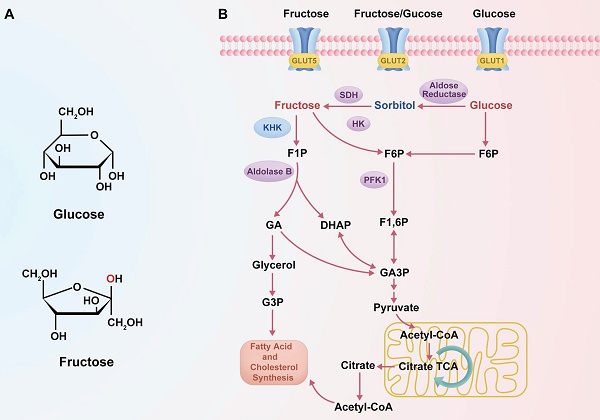
Metabolic reprogramming enables cancer cells to adapt to the tumor microenvironment, facilitating their survival, proliferation, and resistance to therapy. While glucose has long been considered the primary substrate for cancer cell metabolism, recent studies have highlighted the role of fructose as an alternative carbon source. Fructose metabolism, particularly through key enzymes such as ketohexokinase (KHK) and aldolase B (ALDOB), along with the fructose transporter GLUT5, supports tumor growth, metastasis, and therapeutic resistance. This review explores the mechanisms by which fructose metabolism influences cancer progression, focusing on its metabolic pathways and its impact on the tumor microenvironment. By promoting glycolysis, lipid biosynthesis, and nucleotide production, fructose metabolism enhances the metabolic adaptability of cancer cells, especially in glucose-deprived conditions. A comprehensive understanding of these processes offers potential insights into therapeutic strategies targeting fructose metabolism for cancer treatment. However, further studies are required to fully elucidate the complex role of fructose in various malignancies.
Keywords: fructose metabolism, tumor metabolism, metabolic reprogramming, ketohexokinase, aldolase, glucose transporter