Impact Factor ISSN: 1449-1907


 Global reach, higher impact


Int J Med Sci 2024; 21(8):1378-1384. doi:10.7150/ijms.92837 This issue Cite
Research Paper
Validation of the Saga Fall Injury Risk Model
1. Department of General Medicine, Saga University Hospital, Saga, Japan.
2. Graduate School of Public Health, Shizuoka Graduate University of Public Health, Shizuoka, Japan.
3. Shimada Hospital of Medical Corporation Chouseikai, Saga, Japan.
4. Department of General Medicine, Yuai-Kai Foundation and Oda Hospital, Saga, Japan.
Abstract
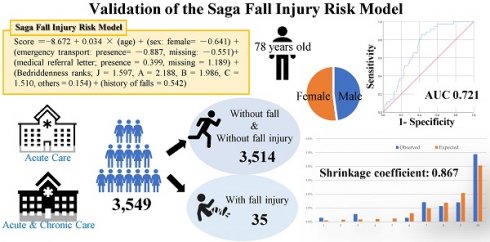
Background: Predicting fall injuries can mitigate the sequelae of falls and potentially utilize medical resources effectively. This study aimed to externally validate the accuracy of the Saga Fall Injury Risk Model (SFIRM), consisting of six factors including age, sex, emergency transport, medical referral letter, Bedriddenness Rank, and history of falls, assessed upon admission.
Methods: This was a two-center, prospective, observational study. We included inpatients aged 20 years or older in two hospitals, an acute and a chronic care hospital, from October 2018 to September 2019. The predictive performance of the model was evaluated by calculating the area under the curve (AUC), 95% confidence interval (CI), and shrinkage coefficient of the entire study population. The minimum sample size of this study was 2,235 cases.
Results: A total of 3,549 patients, with a median age of 78 years, were included in the analysis, and men accounted for 47.9% of all the patients. Among these, 35 (0.99%) had fall injuries. The performance of the SFIRM, as measured by the AUC, was 0.721 (95% CI: 0.662-0.781). The observed fall incidence closely aligned with the predicted incidence calculated using the SFIRM, with a shrinkage coefficient of 0.867.
Conclusions: The external validation of the SFIRM in this two-center, prospective study showed good discrimination and calibration. This model can be easily applied upon admission and is valuable for fall injury prediction.
Keywords: Accidental Falls, Accidental Injuries, Validation Studies, Logistic Models, Risk Factors